Reading guide
Content guideOverview
This opening section of the Qimen Dunjia course begins by unpacking the name itself: the three marvels (yi, bing, ding), the eight gates from Rest to Open, and the six jia hidden beneath the six instruments. It describes the Qimen diagram as four concentric plates—earth, heaven, human, and spirit—each carrying the eight trigrams, nine stars, eight gates, and eight spirits, rotated according to the day and hour to fix a chart. The text separates numerical Qimen, which relies on the diagram for prediction, from ritual Qimen, and divides the numerical school by time into year, month, day, and hour charts, noting that the hour chart is the most widely used and explained in most detail. A further section frames Qimen as a model integrating time, space, human action, and unseen factors. The second chapter turns to fundamentals, starting with the earth plate and the earlier and later heaven arrangements of the eight trigrams in the nine palaces.
Contents
Chapter 1: Getting started with Qimen Dunjia
Numerical Qimen versus ritual Qimen
The four schools: hour, year, month, and day charts
The function of Qimen as a model of time and space
Chapter 2: Basic knowledge of Qimen Dunjia
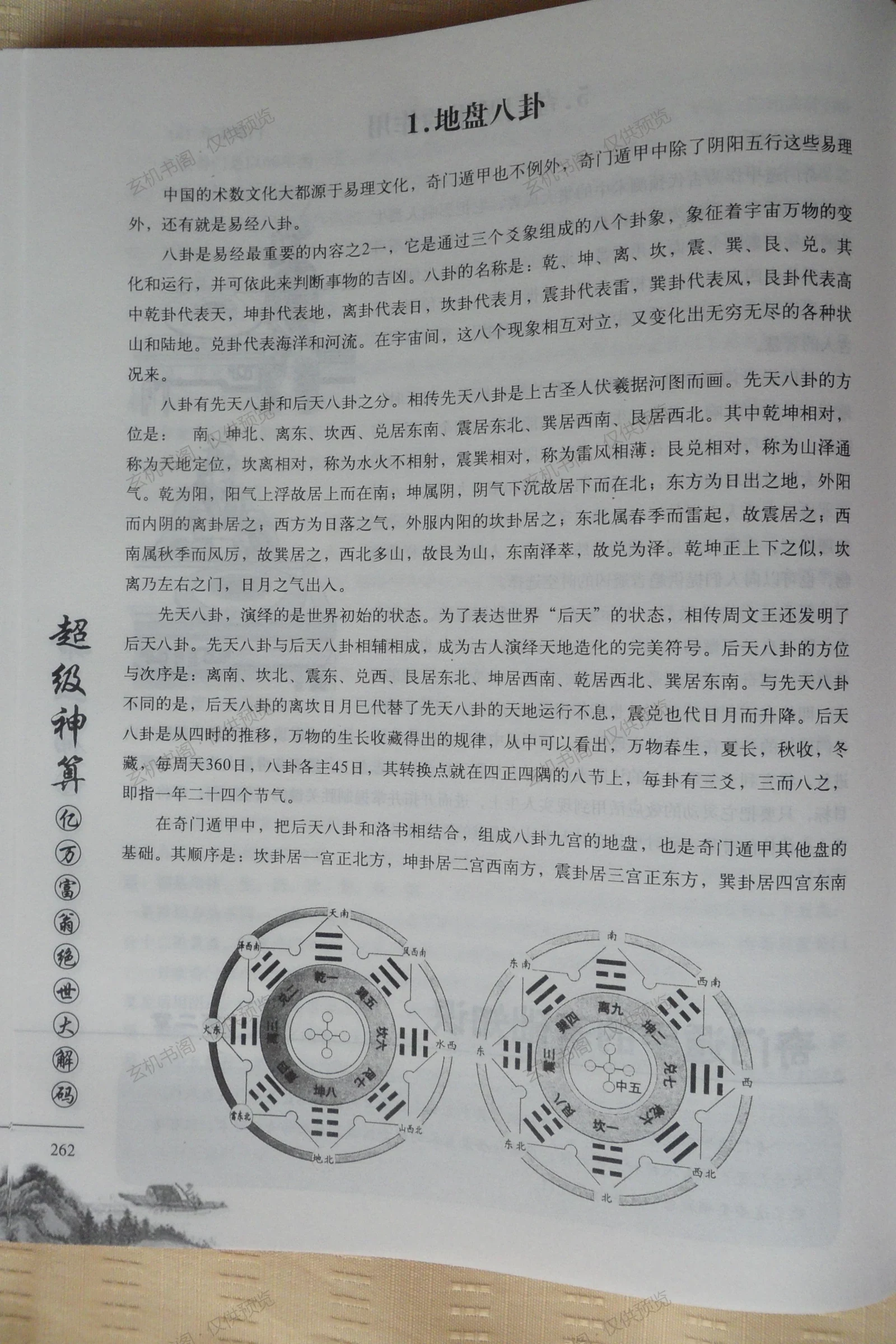
The earth plate: earlier and later heaven trigrams in the nine palaces
Key Points
Three marvels are yi, bing, ding; eight gates run from Rest to Open
The diagram has earth, heaven, human, and spirit plates set by time
Hour charts are most common, followed by day charts
Year, month, day, and hour charts each use different setting rules
The earth plate combines later heaven trigrams with the Luoshu nine palaces