Reading guide
Content guideOverview
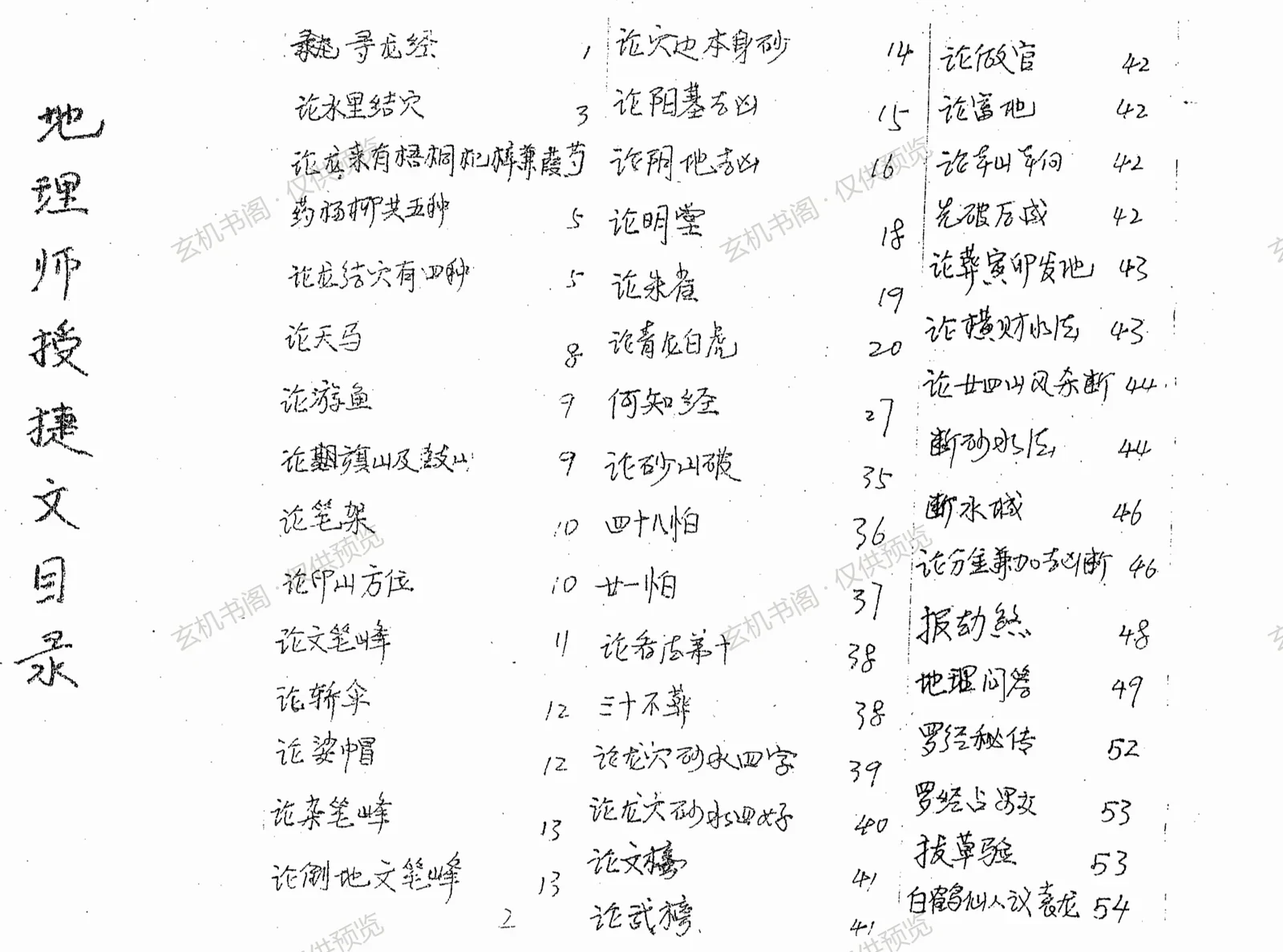
This manuscript, titled simply Master-Transmitted Concise Essays on Geography, is a practical handbook for siting yin dwellings. It opens with the Dragon-Seeking Classic in verse, stressing that one should first inspect the water mouth, the锁 locks and the bright hall, then discusses water-borne nodes and the omens of trees and plants around a site. A long series of shape-based entries likens mountains to heavenly horses, swimming fish, flags and drums, brush racks, seals, sedans and tilted brush peaks. The middle section turns to sand methods around the穴 spot, auspicious and inauspicious yang bases, the bright hall, case mountains, green dragon and white tiger, damaged sand, forty-eight fears and thirty cases not to bury. Later chapters cover division of the compass, sand judgments, earthquake煞, geographical questions and answers, secret transmission of the luopan, and the White Crane Immortal's discussion of noble dragons, ending with the Thousand Gold Ode and various songs. The verse and item format reflects an oral master-disciple tradition and is useful for studying folk feng shui terminology.
Contents
Dragon-Seeking Classic: water mouth and bright hall
Water nodes and plant omens
Shape entries: horse, fish, flags, brush rack
Sand methods: spot, hall, case mountain, dragons
Forty-eight fears and thirty non-burial cases
Luopan secrets and geographical questions
Odes: Thousand Gold, songs and records
Key Points
Verse-style dragon seeking that begins with the water mouth
Many shape-based entries naming mountains after objects
A full sand-method system covering yin and yang sites
Includes luopan secrets and Q&A, typical of a master's manual