Reading guide
Content guideOverview
Where Destiny Leads is a collection of essays by Liao Wu Jushi in the “Destiny and Life” series. Its subtitle asks whether one should accept, follow, or defy destiny. Rather than an introductory Bazi manual, the book discusses the basic structure of fate calculation, inference techniques, the rise and fall of fortune, and the limits of what fate calculation can actually do. In the preface the author explains that the aim is to clarify the relationship between fate and fate calculation, using everyday situations and social examples as illustrations, with references to Bazi charts as supporting evidence. The table of contents includes pieces such as “Professor Fortune-Telling,” “The Birth of a Genius,” “Destined,” “Astrological Charts,” “The Theory of the Soul,” “Trading Lifespan for High Office,” and “The Fate of a Presidential Candidate,” followed by a list of the author’s works. The value of the book lies less in memorizing formulas than in understanding what fate calculation can and cannot claim, and what the three attitudes of accepting, following, and defying destiny really mean.
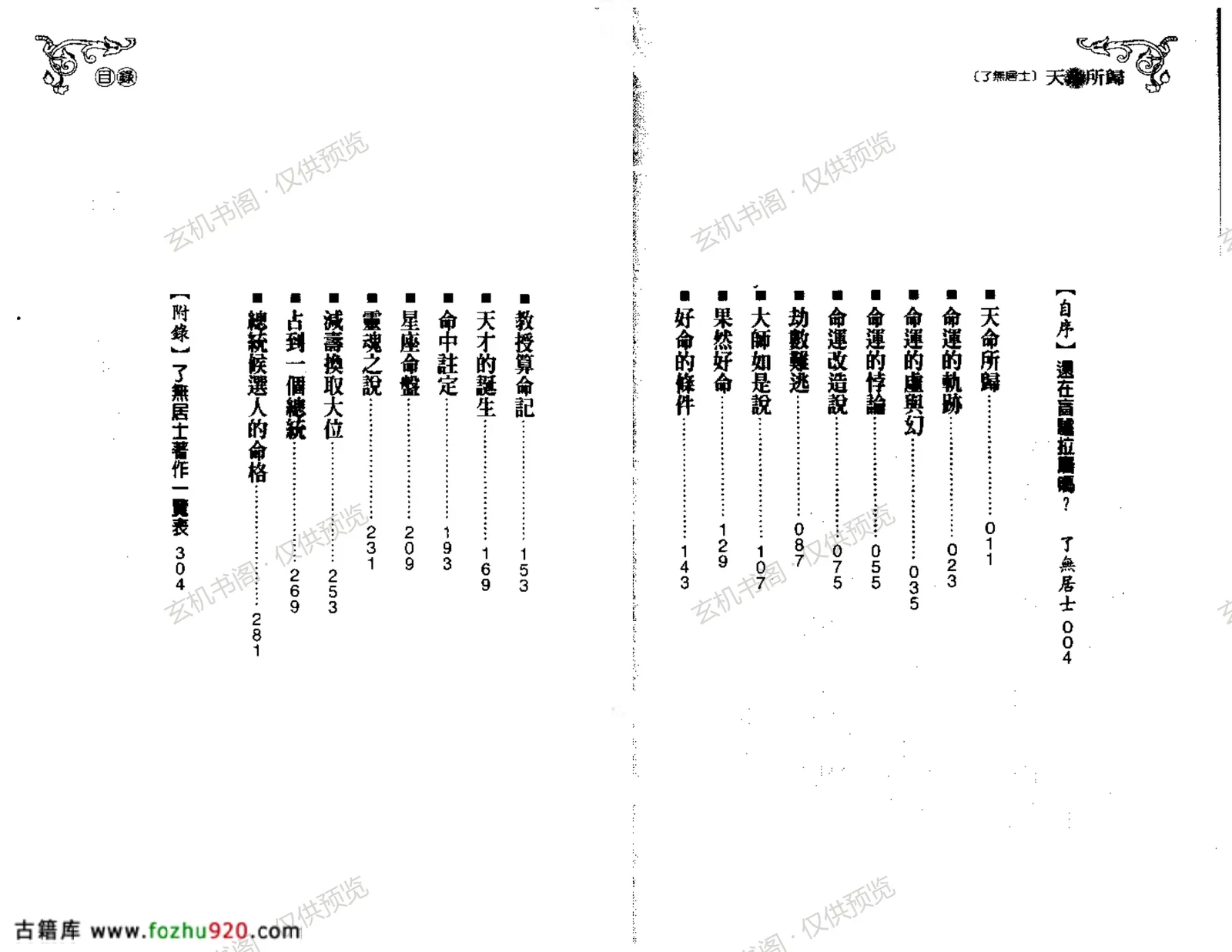
Contents
Preface: Still Grinding Like a Blind Turtle?
Where Destiny Leads; The Track of Fate; The Illusion of Fate
The Experience of Fate; Remaking Fate; Inescapable Tribulation
Thus Spoke the Master; Truly Good Fate; Conditions for a Good Fate
Professor Fortune-Telling; The Birth of a Genius; Destined
Astrological Charts; The Theory of the Soul; Trading Lifespan for High Office
Drawing a Bad Lot; The Fate of a Presidential Candidate
Appendix: A List of Liao Wu Jushi’s Works
Key Points
Discusses fate calculation through essays rather than a step-by-step Bazi textbook.
Repeatedly asks what fate calculation can and cannot claim to do.
Explores three attitudes toward destiny: accepting, following, and defying it.
Uses everyday situations and social examples to illustrate fate judgments.
Criticizes street fortune-telling and crude statistical methods.