Reading guide
Content guideOverview
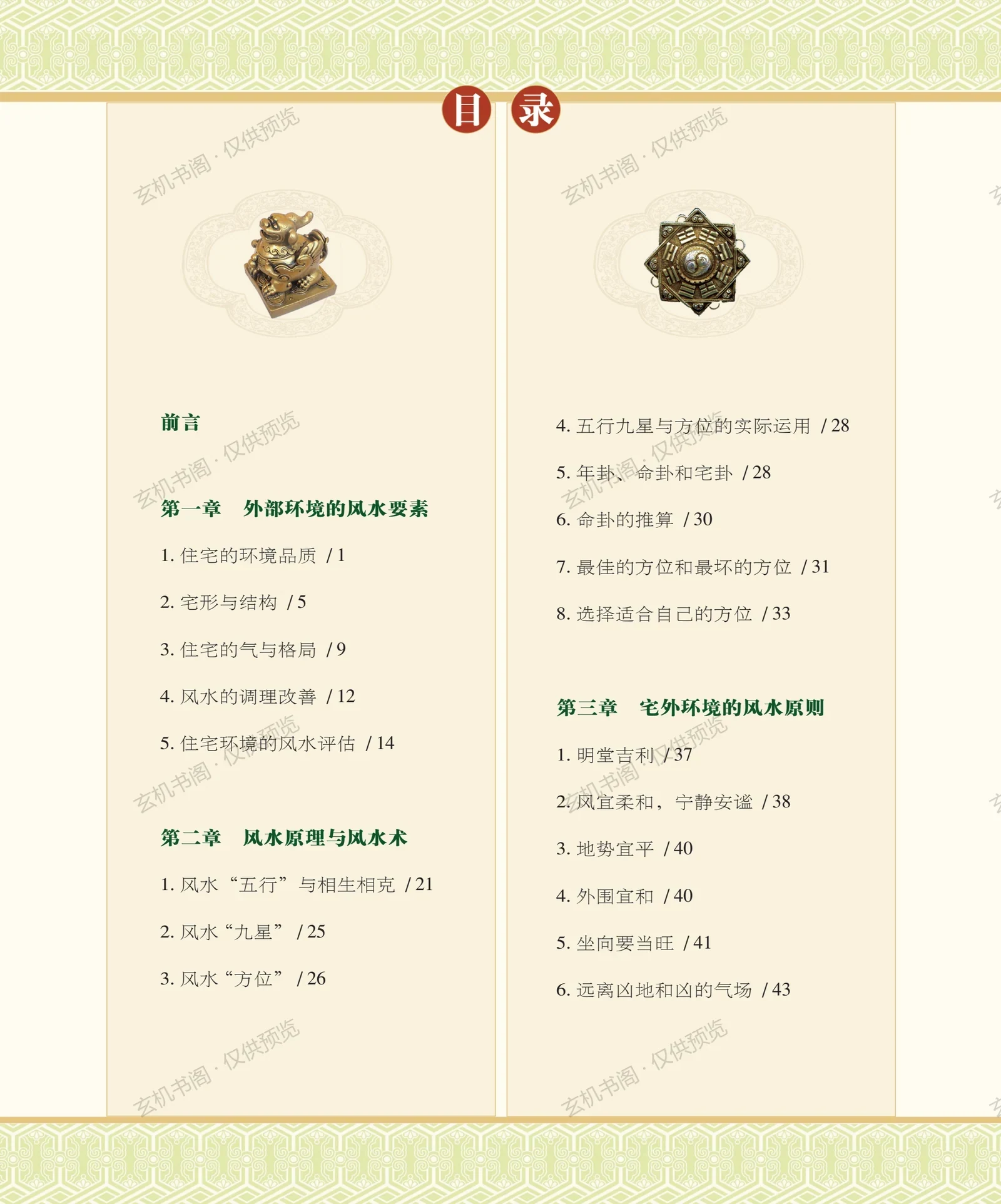
Part of the Residential Decoration Feng Shui Wisdom series, this book is edited by Xi Yu and published by Tongji University Press in 2008. The preface argues for treating feng shui as an empirical record of dwelling environments, linking traditional taboos such as glaring light and draughts to practical concerns like lighting, ventilation and hygiene, while cautioning against superstition. The main text has three chapters: external environmental factors such as site quality, house form, qi and layout, remedies and assessment; feng shui theory and techniques including the five elements, nine stars, directions, annual and life trigrams, life-trigram calculation and choosing suitable orientations; and outdoor principles such as an open bright hall, gentle wind, level terrain, harmonious surroundings, auspicious sitting and facing, and avoiding harmful sites. Organized in short sections with illustrations, it suits readers who want an accessible entry to traditional residential feng shui from the angle of environment and site selection.
Contents
Preface: feng shui through experience and science
Ch.1 Feng shui factors of the exterior environment
Ch.2 Feng shui theory and techniques
Ch.3 Outdoor feng shui principles
Key Points
Focuses on exterior environment and site selection rather than interior decor
Builds a basic framework with the five elements, nine stars and directions
Explains annual, life and house trigrams and life-trigram calculation
Sets out outdoor principles such as bright hall, terrain and orientation
Treats feng shui as empirical observation, useful but not to be taken as superstition