Reading guide
Content guideOverview
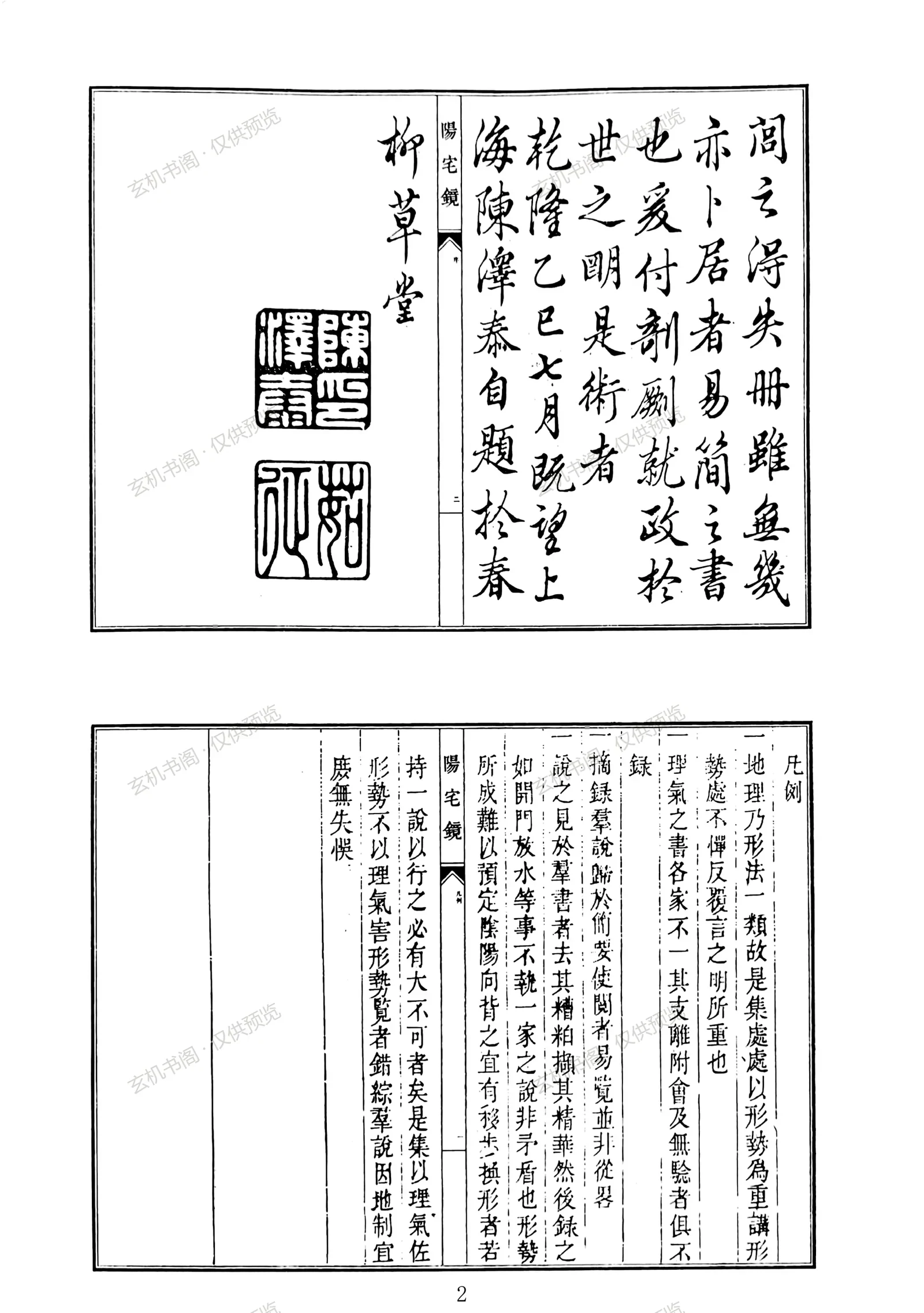
Mirror of Yang Dwellings (Yangzhai Jing) is a Qing-era feng shui text compiled by Chen Zetai, with a preface dated to 1785 and a section of editorial notes. The surviving portion is labeled 'Volume One of Zhai Jing.' The work follows the form school (xingshi pai), stating in its notes that geography is a method of forms and that the collection therefore emphasizes landscape configuration throughout. It first discusses dragon-vein tendencies and the selection of yin and yang sites, then treats house forms, base fortunes, and the diaoti system. It lists eight palace-mountain configurations (Qian, Kan, Gen, Xun, Li, Kun, Dui) and discusses nine-palace overlays and various schools of judgment. Later sections address sand, water, bright halls, roads, temples, trees, and wells as concrete omens. The text combines general theory with numerous field-observation guidelines, making it useful for readers studying Qing-dynasty form-school yang dwelling practice.
Contents
Preface and editorial notes: purpose and form-school stance
Dragon-vein tendencies: veins, nodes, yin and yang sites
House forms and base fortunes: forms and diaoti cycles
Eight palace-mountain configurations
Nine-palace overlays and schools of judgment
Sand, water, and omens: halls, roads, temples, wells
Key Points
Form-school focus, explicitly emphasizing landscape configuration throughout.
Discusses dragon veins, nodes, and yin-yang site selection.
Lists eight palace-mountain configurations and nine-palace overlays.
Gives many concrete omens involving roads, temples, trees, and wells.