Reading guide
Content guideOverview
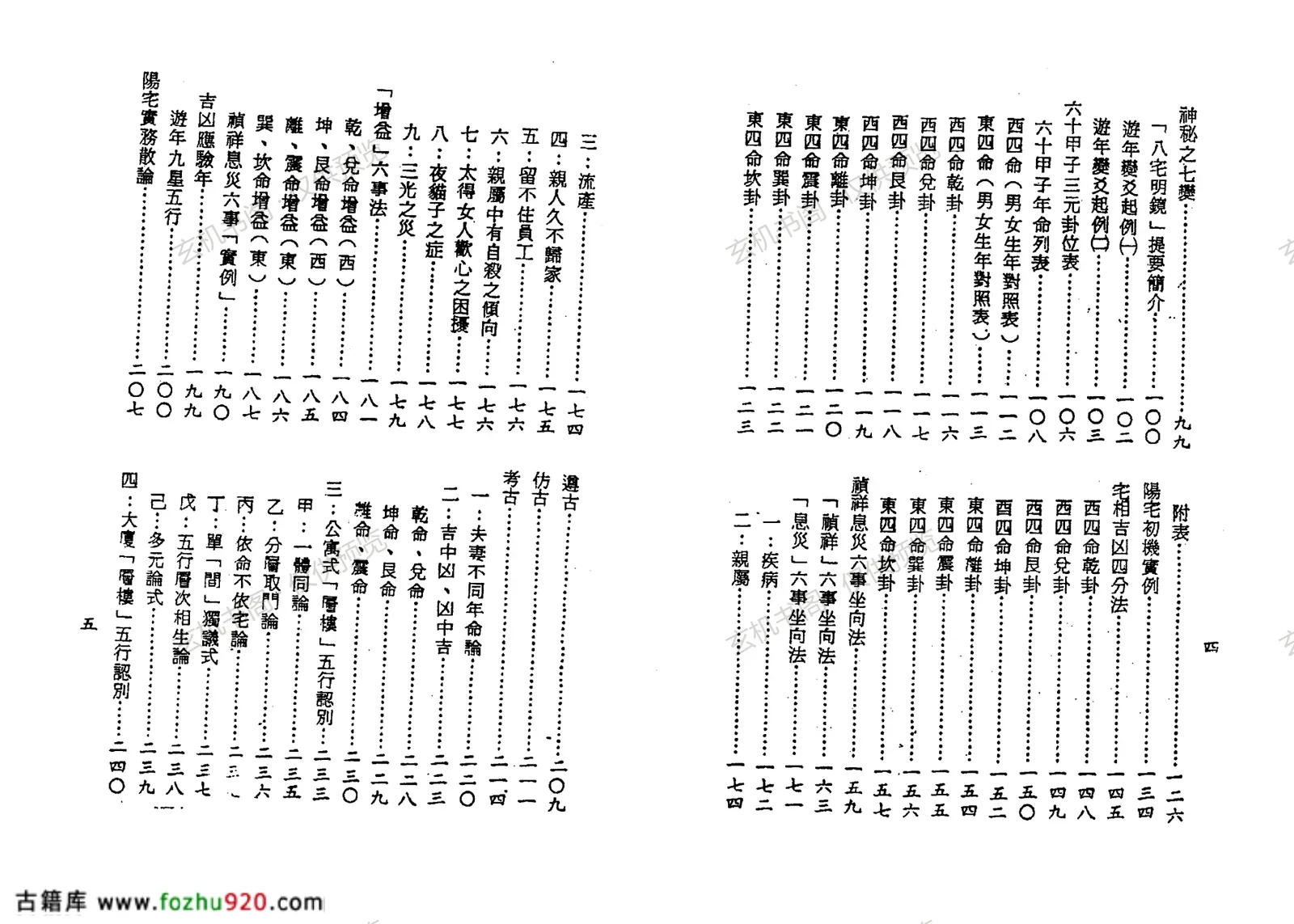
This is a practical yangzhai feng shui manual by Liang Xiangrun. The table of contents is organized into eight sections: revelations on yangzhai, the author's intellectual journey, dual-sided mind-power, the mind of a feng shui master, five core beliefs of yangzhai practice, the will to survey a dwelling, the 'mind, facing, dwelling' framework, and a hundred illustrations of form methods. The main text begins with the philosophical and cultural meaning of 'yangzhai,' describing it as a blend of architectural art, folk custom, and Five Elements numerology, then moves to operational topics: sitting and facing, determining the dwelling and its orientation, classical methods of 'facing' and 'door,' Three Yuan sitting-mountain theory, multiple-plate methods, and the ten-year wandering-star method. It includes summaries of the Bazhai Mingjing, rules for deriving wandering stars, a sexagenary Three Yuan gua-position table, East and West Four Life gua, auspicious and inauspicious minggua, the six matters method, a hundred illustrations of form methods (central palace lanes, doors, stoves, spirit seats, bridges, trees, etc.), and topics such as repair directions, relocation, annual and monthly cycles. It is an important reference for studying practical yangzhai feng shui in Taiwan.
Contents
Revelations on yangzhai: cultural and philosophical background
The author's journey, dual-sided mind-power, and the master's mind
Five core beliefs and the will to survey a dwelling
Sitting and facing, determining the dwelling, door orientation, and Three Yuan sitting mountains
Bazhai wandering stars, minggua, and annual nine stars
Six matters method and a hundred illustrations of form methods
Form methods for stoves, doors, spirit seats, bridges, and trees
Repair directions, relocation, and annual taboos
Key Points
Organized around 'mind, facing, dwelling,' emphasizing practice over abstract theory
Includes complete tables for Bazhai wandering stars, Three Yuan minggua, and annual nine stars
The hundred illustrations section uses diagrams to discuss dwelling shapes and surrounding objects
Appends a sexagenary Three Yuan gua-position table for looking up minggua and dwelling gua
Discusses practical form issues such as doors, stoves, spirit seats, lane conflicts, and bridges