Reading guide
Content guideOverview
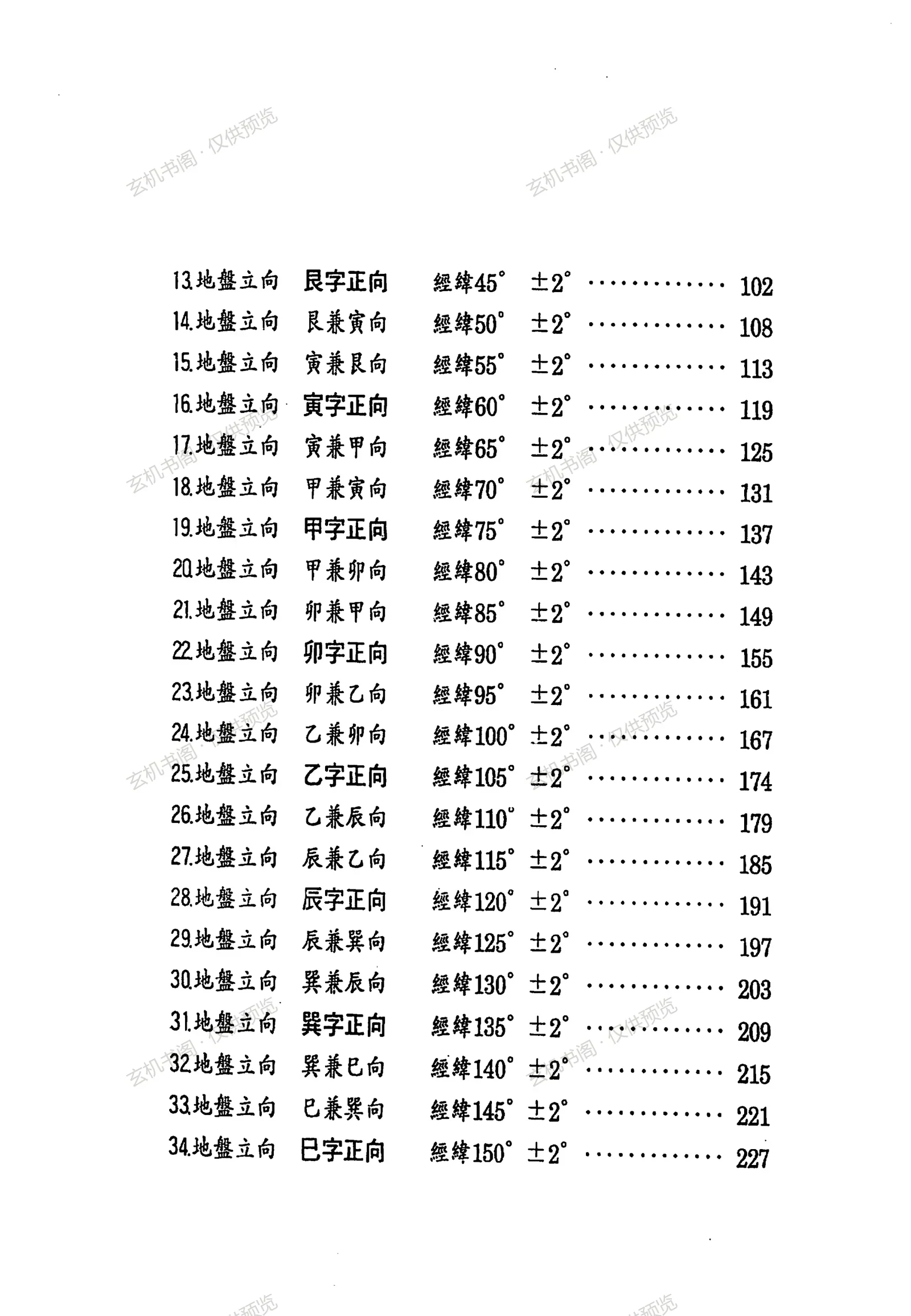
This is a specialized manual on yang-dwelling feng shui by the Taiwanese author Chang Ching-ho, who dates his preface to the summer of 1999 and describes himself as born in 1930 and living at a mountain retreat in Changhua. The book is built on the earth-plate orientation of the Sanhe compass: the full 360 degrees are divided into seventy-two entries at five-degree intervals, each tied to a stated longitude and a tolerance of plus or minus two degrees. Chapter one sets out basic notions of yang-dwelling geography and local terrain; chapter two first explains how to establish orientation for a building, then uses diagrams to show the auspicious or harmful effects of walls, doors, beds and desks in each sector, together with remedies. The preface argues that sunlight angles and the qi emitted by objects affect the health of occupants, and recommends the Later Heaven bagua, the Sanhe compass, najia qi, pure yin-yang and the sixty-four hexagrams as the framework for adjustment. The result is a highly indexed reference that lets a reader look up a compass bearing directly and compare it with the corresponding chapter, best suited to those who already know the Sanhe plate and want practical charts to consult.
Contents
Preface: qi of heaven and earth and yang-dwelling response
Ch. 1: yang-dwelling geography and local terrain notes
Ch. 2: essentials of determining building orientation
Diagrams of wall, door, bed and desk fortune and remedies
Seventy-two earth-plate orientation entries by degree
Key Points
Earth-plate orientation is the core, divided every five degrees
Each entry gives longitude and a plus or minus two degree tolerance
Placement of walls, doors, beds and desks is illustrated entry by entry
Combines Later Heaven bagua, najia qi and sixty-four hexagram methods
Stresses aligning with compass lines to improve family health and fortune