Reading guide
Content guideOverview
This book is a transcript of Yiting's systematic class, presented as a group chat with time stamps and hand-diagnosis diagrams. It begins with simple palm observation, noting the color of the thenar eminence and the upper and lower palm, and touches on the four diagnostic methods of Chinese medicine. From the question of why liver disease shows in the eyes, the teacher introduces holographic theory: the part reflects the whole, and fate charts unfold across multiple dimensions at once. This leads to casting by correspondence, where word counts, time, clothing color, or even a mis-entered chart can all serve as omens. The later pages discuss why people born at the same moment differ: the act of asking creates the hexagram, and one chart can be read for many people. A final section on the channel idea links fortune sticks, good feng shui, rebirth, and the law of attraction, stressing the importance of positive emotion.
Contents
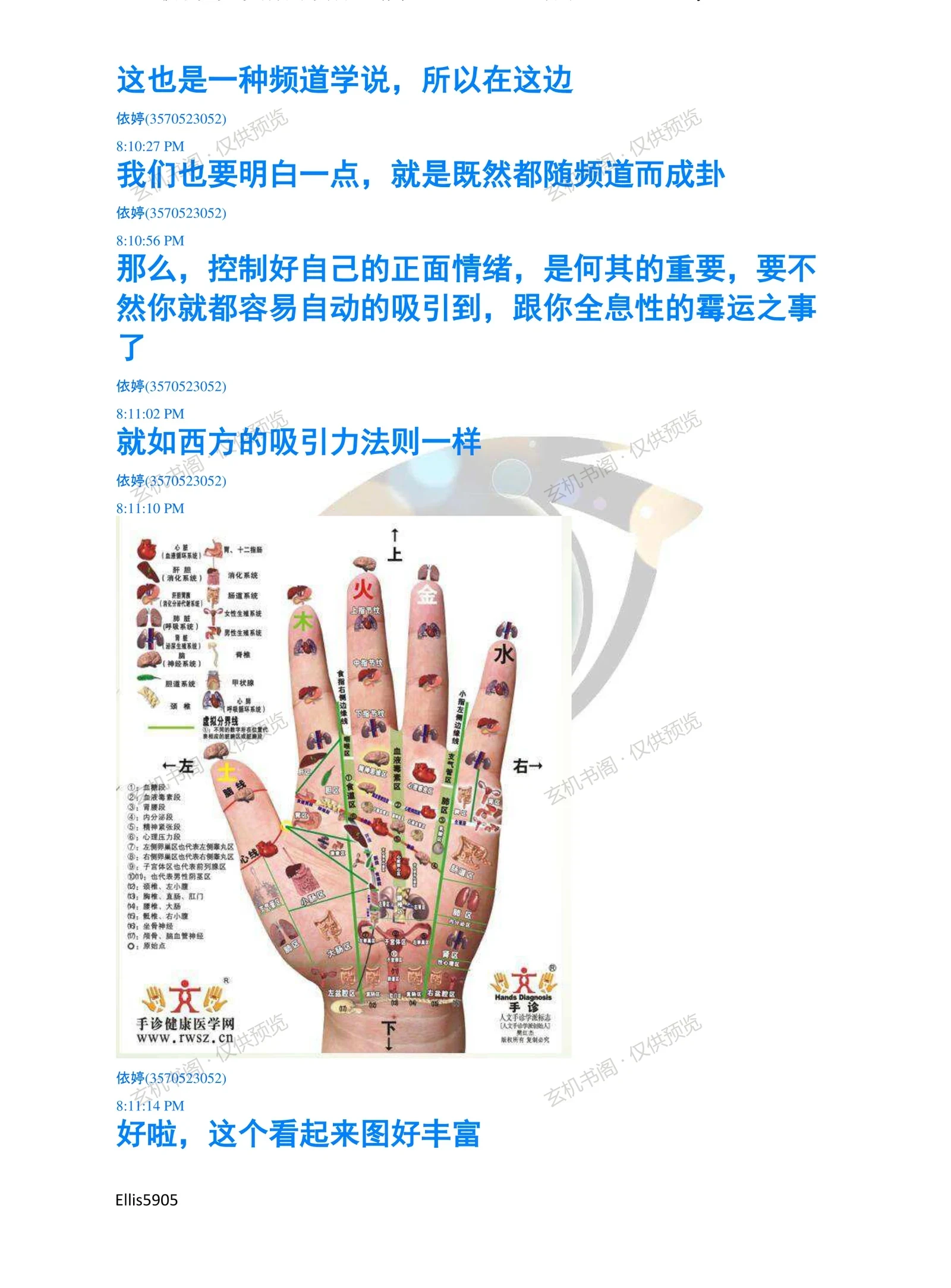
Hand diagnosis diagrams and palm color observation
Chinese medicine diagnostics and holographic theory
Casting by correspondence from everyday signs
Same chart, different lives, and the question as hexagram
Mistaken charts as valid omens and multi-person readings
Channel theory and emotional attraction
Key Points
Hand diagnosis serves as an entry point to holographic thinking.
Holographic theory links local signs to whole-body and whole-chart patterns.
Asking a question is itself the act of casting a hexagram.
A wrongly entered chart is still treated as a readable omen.
The channel idea connects divination, feng shui, and rebirth to emotional states.