Reading guide
Content guideOverview
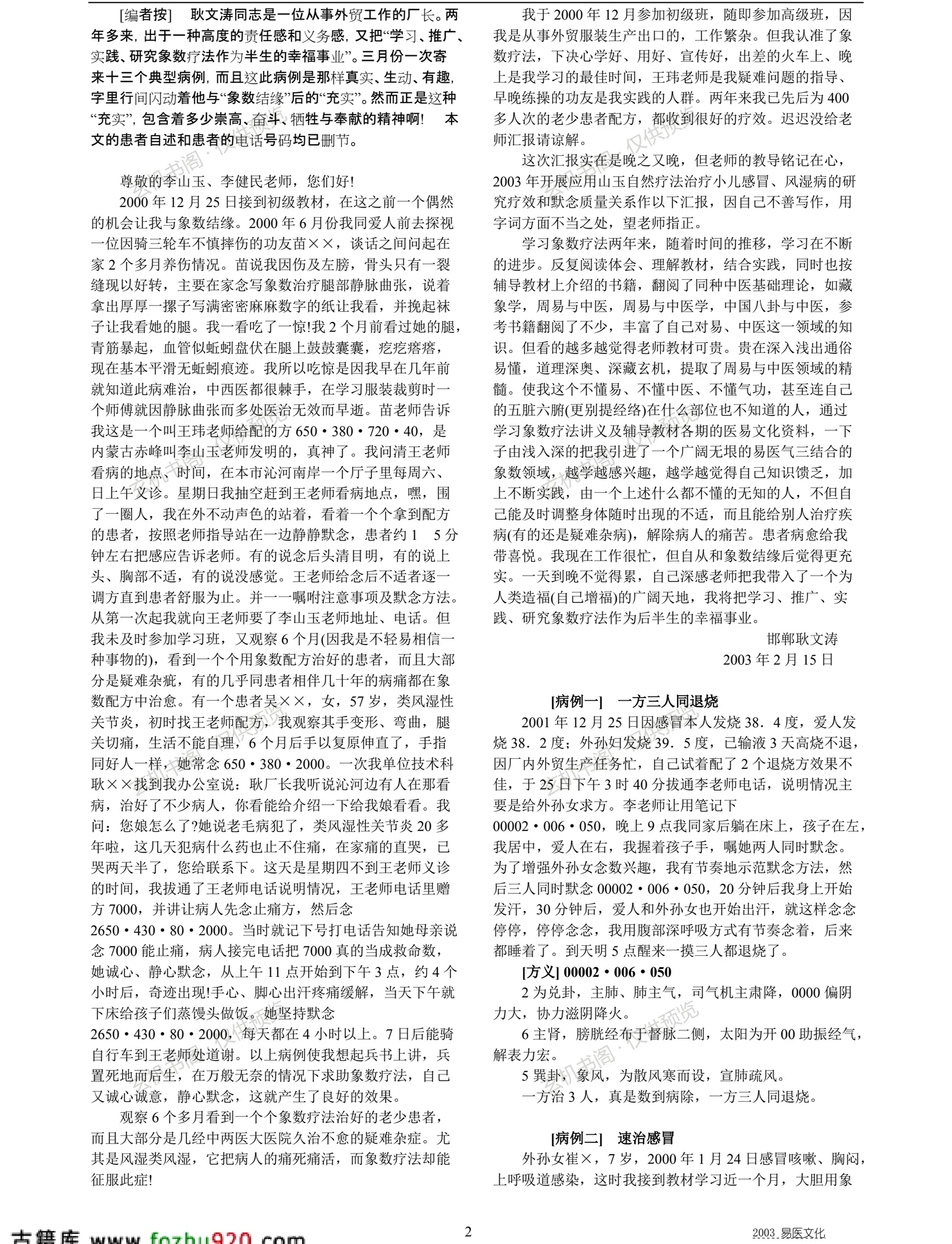
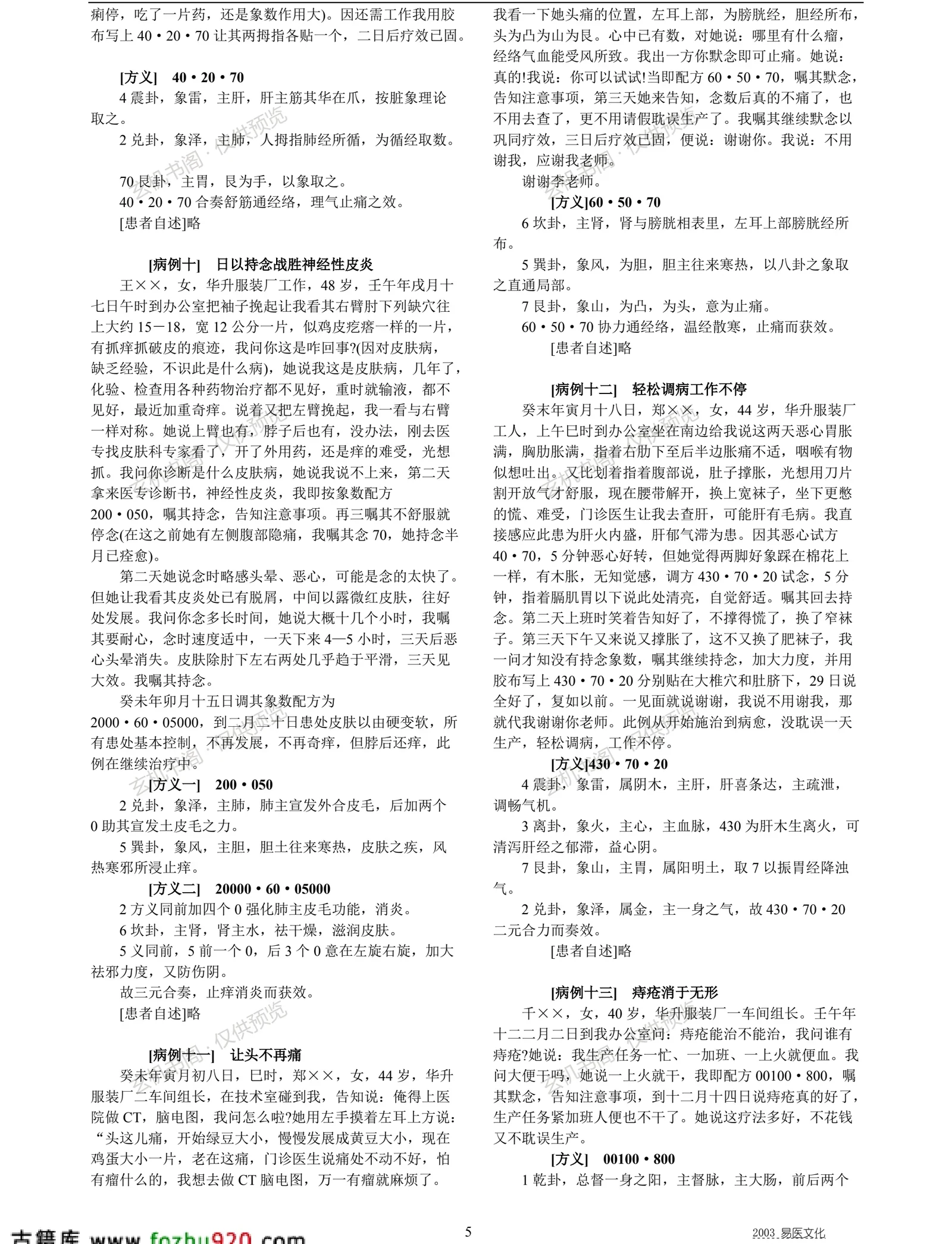
This 2003 volume of Yi Medicine Culture opens with a ten-year personal account by Zha Yitang, followed by practice reports from Geng Wentao, Yang Weixin, Zhang Jiren and others. The core of the book is a series of case records, each giving the patient's age, sex, occupation and symptoms, a numerical formula to be recited silently (for example 00002·006·050 or 40·70·20·650), and a 'formula meaning' section explaining how trigrams such as Dui for the lungs, Gen for the stomach, Kan for the kidneys and Zhen for the liver map onto the body. Conditions covered include fever, cough, rheumatoid arthritis, urticaria, vomiting and diarrhea, excessive phlegm, lethargy, tenosynovitis, neurodermatitis, headache and hemorrhoids. The book stresses sincere belief, quiet recitation and the correspondence between trigram numbers and internal organs, making it a practical case compilation for readers interested in folk Yi medicine and number-based therapy.
Contents
Zha Yitang: Ten years with number therapy
Geng Wentao: Practice report
Cases 1-4: fever, cold, urticaria, vomiting
Cases 5-8: joint pain, vitiligo, phlegm, lethargy
Cases 9-13: tenosynovitis, dermatitis, headache, hemorrhoids
Yang Weixin: granddaughter's myocarditis and in-law's heart disease
Zhang Jiren: self-treatment of leg swelling
Key Points
Trigram numbers (Qian 1, Dui 2, Li 3, Zhen 4, Xun 5, Kan 6, Gen 7, Kun 8) are mapped to organs and body parts.
Formulas typically consist of three or four numbers joined by dots, such as 40·70·20·650.
Sincere belief and calm recitation are presented as essential to the method.
Each case ends with a 'formula meaning' explaining trigram, Five Elements and symptom correspondences.
Cases span external, skin, joint, digestive and neurological complaints.