Reading guide
Content guideOverview
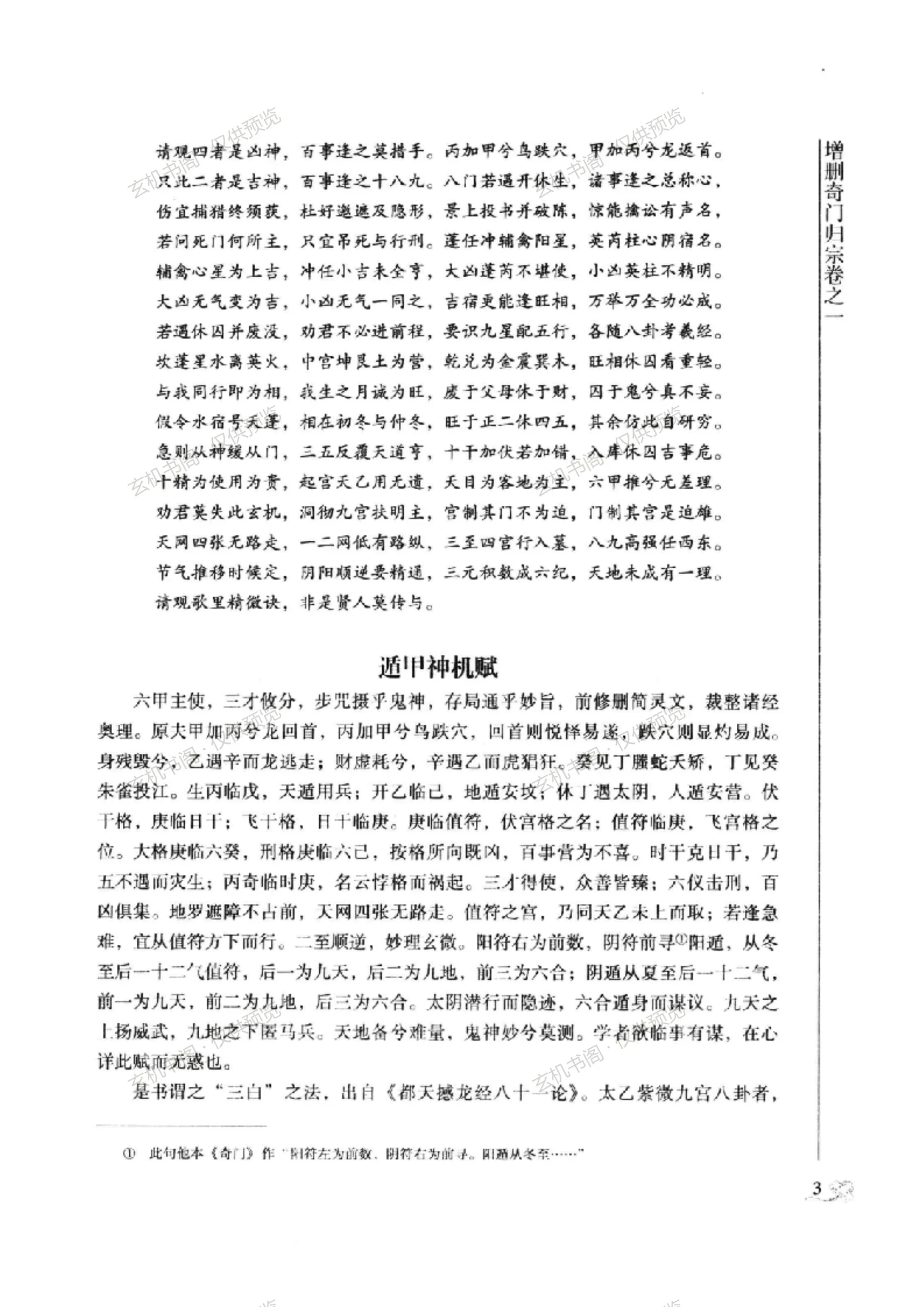
This is volume one of Zengshan Qimen Guizong, headed 'Basic Examples.' It opens with an explanation of Qimen terminology—Dunjia, the Three Marvels (Yi, Bing, Ding), the Six Yi, the Eight Gates, Nine Stars, and Eight Spirits—and how these are positioned on the earth and heaven plates. It then presents the 'Yanbo Diaosou Ge,' a mnemonic poem on yin-yang forward and reverse cycles, the nine palaces and eight trigrams, and the three-epoch method of setting a chart, followed by line-by-line commentary on the Three Marvels, Six Yi, gate conflicts, punishments, and fu-yin/fan-yin patterns. A further section, 'Dunjia Shenji Fu,' discusses the Six Jia as agents and the Three Powers. The closing sections detail chart layout: the upper, middle, and lower epochs, arranging the Six Yi forward and the Three Marvels backward in yang dun (and the reverse in yin dun), determining the epoch by solar term and the chart by day; and 'Chao Shen Jie Qi,' which distinguishes four timing methods—zhengshou, chaoshen, runqi, and jieqi—and explains intercalation. It is a foundational text on Qimen chart construction and pattern judgment for readers with some prior background in Chinese numerology.
Contents
Explanation of Qimen terms: Dunjia, Three Marvels, gates, stars, spirits
Yanbo Diaosou Ge: mnemonic poem with commentary
Dunjia Shenji Fu: Six Jia and the Three Powers
Chart layout: three epochs, yang forward and yin reverse
Chao Shen Jie Qi: zhengshou, chaoshen, runqi, jieqi
Key Points
Defines the Three Marvels, Six Yi, Eight Gates, Nine Stars, and Eight Spirits
Uses the Yanbo Diaosou Ge to survey chart setup and patterns
Explains arranging Six Yi forward and Three Marvels backward in yang dun
Details the timing rules of chaoshen, jieqi, and intercalation