Reading guide
Content guideOverview
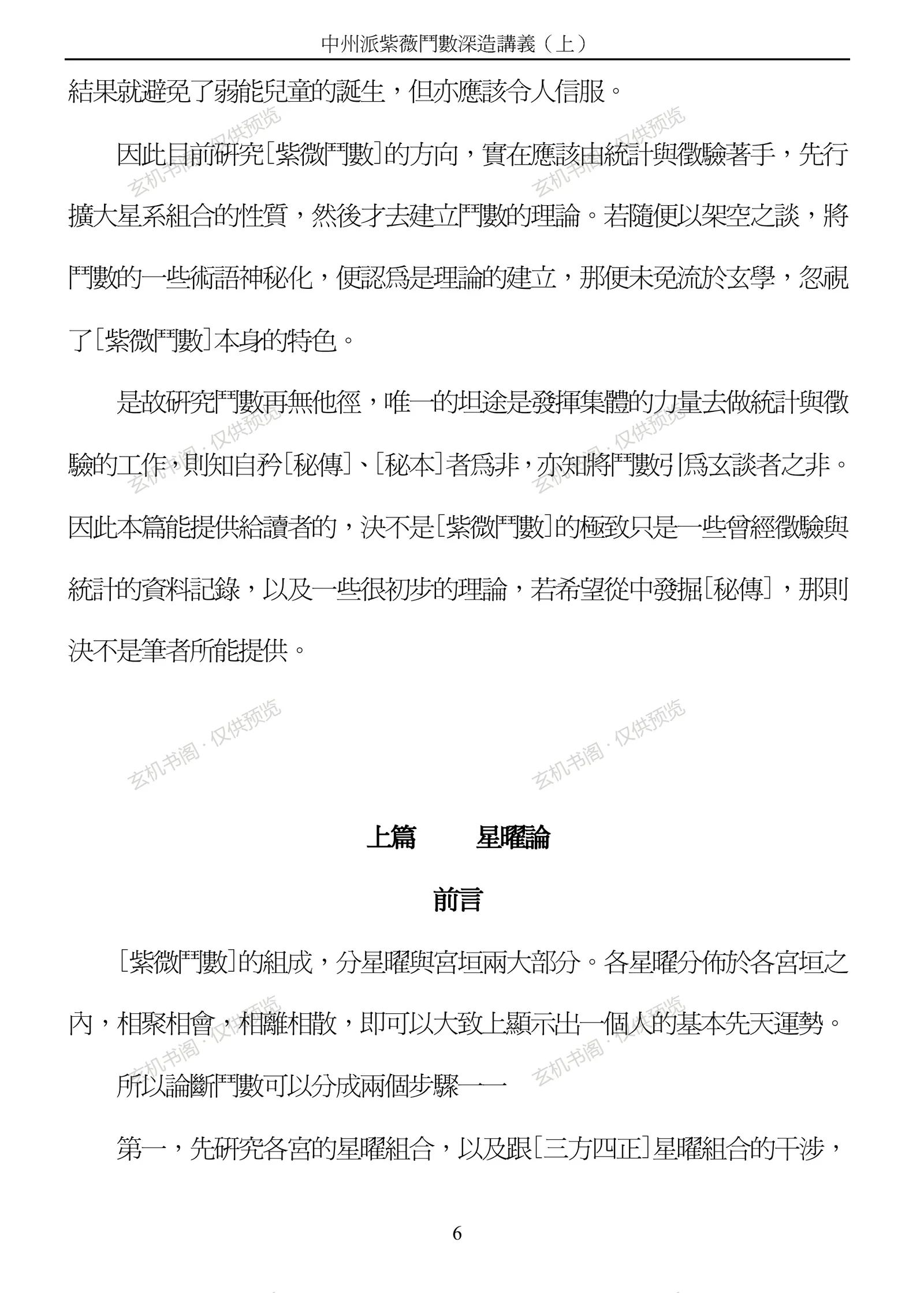
This is the first part of Wang Tingzhi's advanced lectures on Zhongzhou-school Zi Wei Dou Shu, devoted to star theory. The contents move from an introduction and preface through the fourteen primary stars, the sixty star systems, the eight auxiliary stars, miscellaneous stars, transformational stars, general discussions of miscellaneous and fleeting stars, and the temple/fallen status of stars. In the preface the author argues that Zi Wei Dou Shu has long lacked a theoretical foundation, that old texts such as the Complete Book of Zi Wei Dou Shu were poorly edited and full of assertions without reasoning, and that research should proceed from statistics and empirical verification by expanding the study of star combinations rather than mystifying terminology or claiming secret transmissions. The main preface explains that a chart consists of stars and palaces, and that judgment has two steps: first the star combinations in each palace and their interference with the trine and four cardinal points, then the palaces themselves. The book suits readers with basic knowledge of Zi Wei Dou Shu who want a deeper grasp of star qualities and the Zhongzhou approach.
Contents
Preface: weak theory, call for statistics and verification
Introduction: stars and palaces; two steps of judgment
Fourteen primary stars and their qualities
Sixty star systems and their combinations
Auxiliary, miscellaneous and transformational stars
Miscellaneous and fleeting stars; temple and fallen states
Key Points
Advocates statistics and empirical verification over mysticism
Judgment proceeds from star combinations to palaces
Emphasizes interference among stars in the trine and four points
Criticizes reliance on 'secret transmissions' and 'secret texts'
Holds that postnatal human action can alter innate trends