Reading guide
Content guideOverview
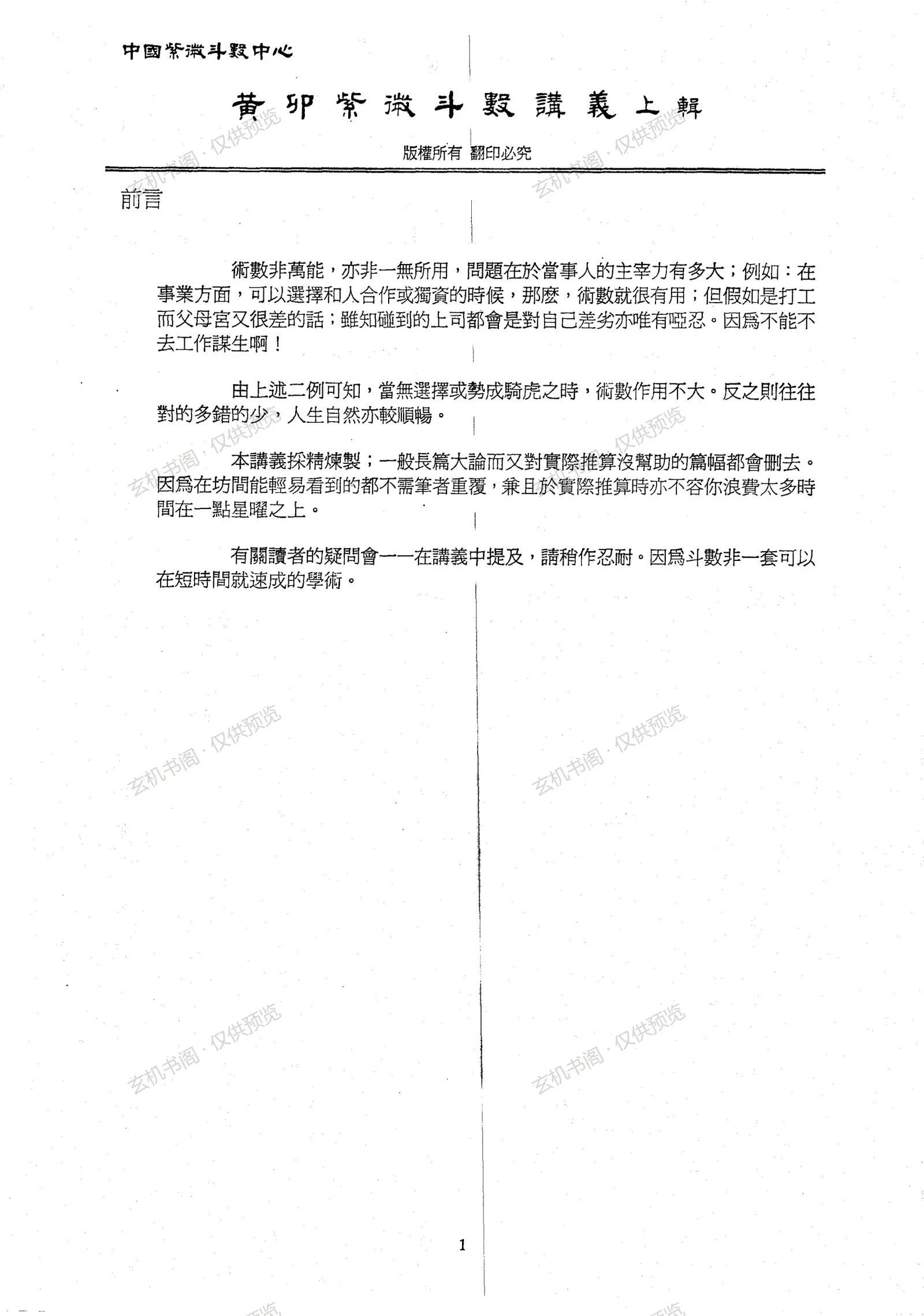
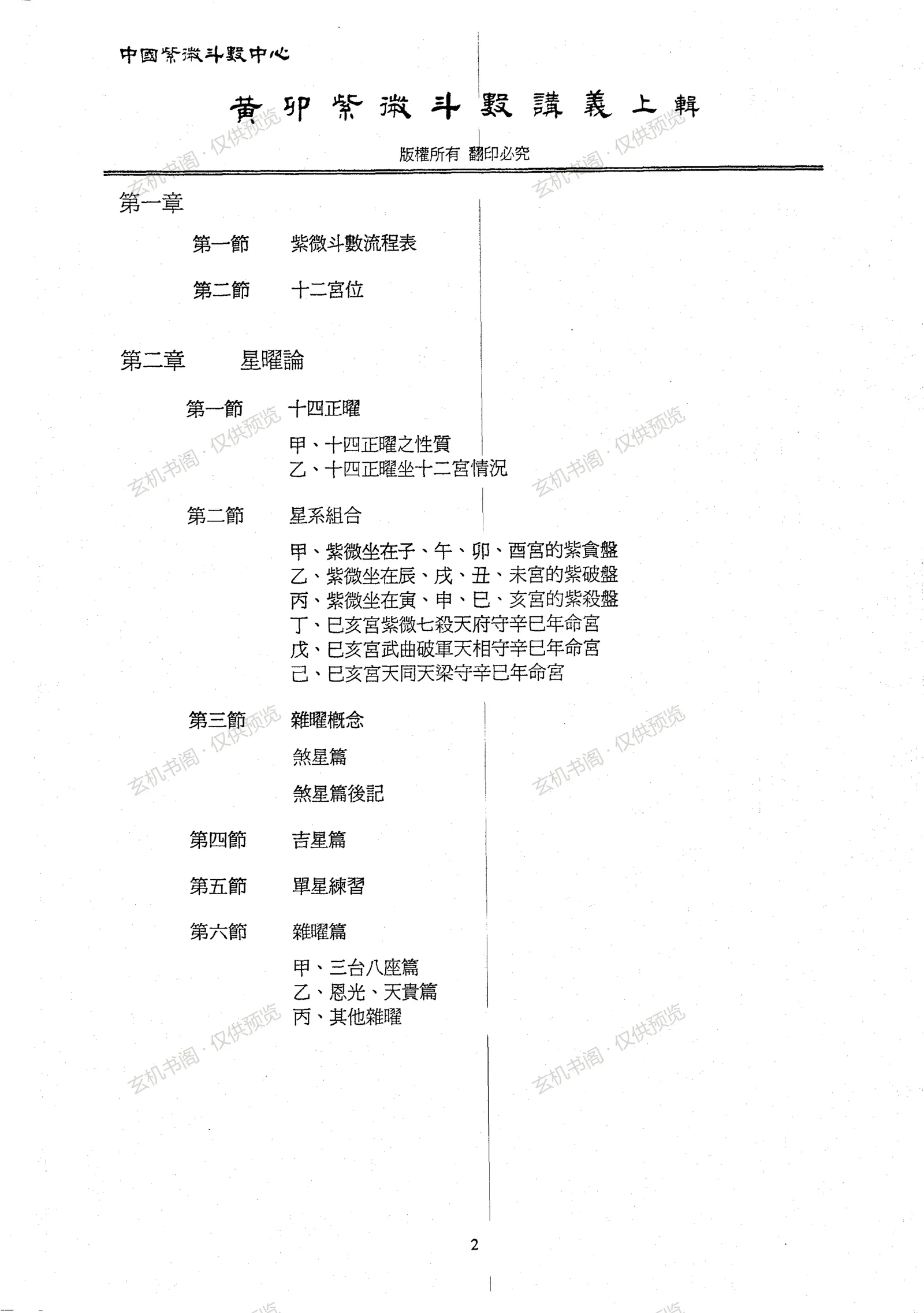
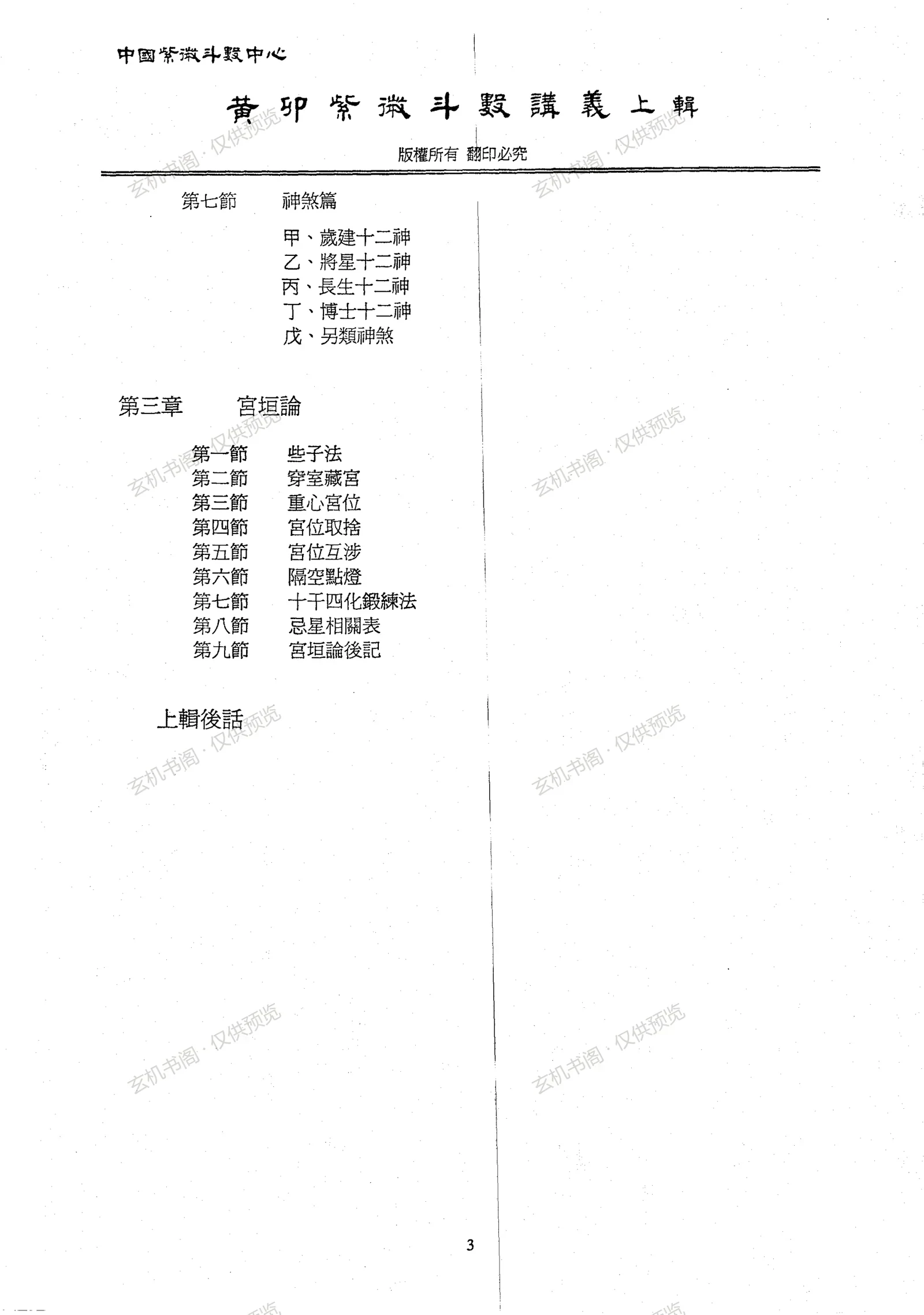
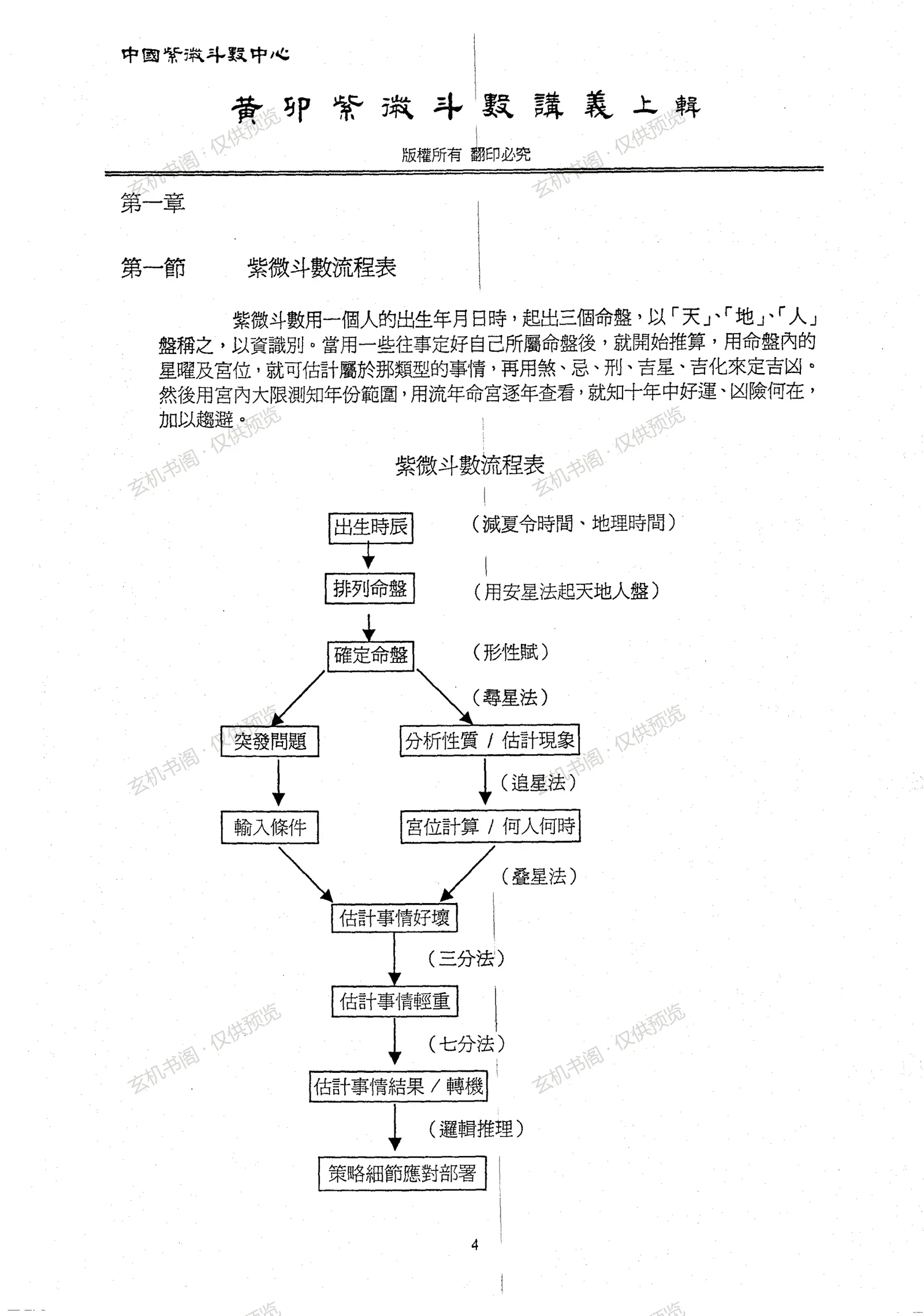
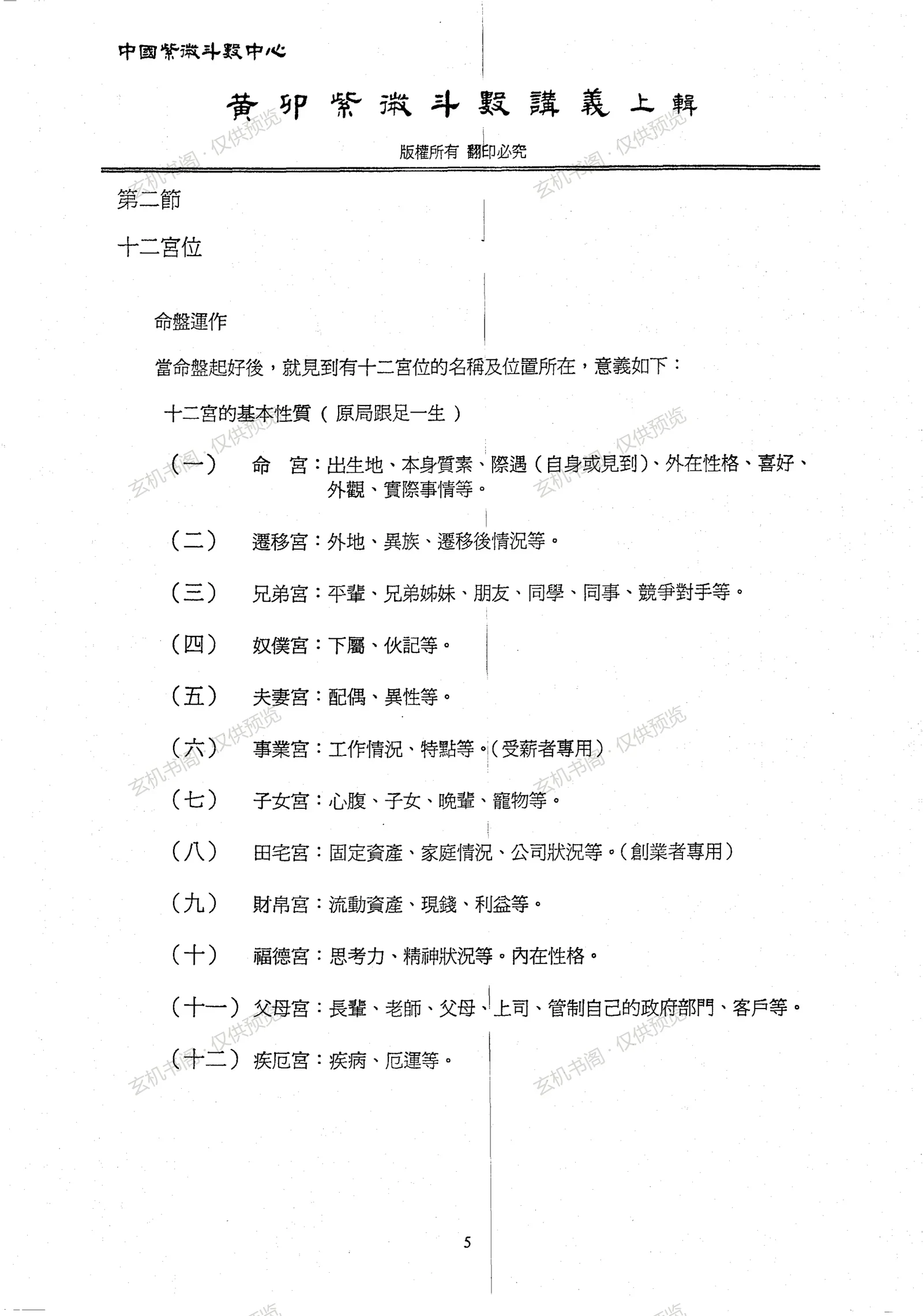
This is the first volume of Huang Mao's Zi Wei Dou Shu correspondence-course lectures, issued by the Chinese Zi Wei Dou Shu Center. The preface argues that divination is neither omnipotent nor useless; its value depends on how much control and choice a person has, and it notes that the lectures omit lengthy general discussion and material easily found elsewhere, warning that Dou Shu cannot be mastered quickly. Chapter One presents a flowchart of Dou Shu practice, from birth time and chart casting through fixing the chart, inputting conditions, calculating palaces, and estimating the severity and outcome of events by three-part and seven-part methods, ending with strategic deployment. It then explains the basic nature of the twelve palaces—Life, Travel, Siblings, Servants, Spouse, Career, Children, Property, Wealth, Virtue, Parents, and Illness. Chapter Two, on stars, covers the nature of the fourteen major stars and their placement in the twelve palaces; star combinations organized by where Zi Wei sits, such as the Zi Wei-Tan Lang, Zi Wei-Po Jun, and Zi Wei-Qi Sha configurations, with examples of Zi Wei and Qi Sha with Tian Fu, Wu Qu and Po Jun with Tian Xiang, and Tian Tong with Tian Liang guarding the Life Palace in the Hai and Si branches; miscellaneous stars including malefics; auspicious stars; single-star practice; and miscellaneous stars such as San Tai, Ba Zuo, En Guang, and Tian Gui. Chapter Three, on palaces, discusses the die-zi method, penetrating hidden palaces, the weighted palace, palace selection, mutual palace reference, spaced-point illumination, the ten-stem four-transformation exercise, and a table of related malefic stars. A closing note ends the volume. It suits readers with basic Dou Shu knowledge who want a systematic review of star and palace judgment.
Contents
Chapter 1: Dou Shu flowchart and the twelve palaces
Chapter 2: Star theory—fourteen major stars and their palace placements
Star combinations: Zi Wei-Tan Lang, Zi Wei-Po Jun, Zi Wei-Qi Sha, etc.
Miscellaneous stars, malefics, and auspicious stars
Miscellaneous stars: San Tai, Ba Zuo, En Guang, Tian Gui
Chapter 3: Palace theory—die-zi method and mutual palace reference
Ten-stem four-transformation exercise and malefic-star table
Key Points
A flowchart links chart casting, chart fixing, palace calculation, and outcome estimation.
Each of the twelve palaces is explained in terms of its basic life themes.
The fourteen major stars are discussed by nature and by placement in each palace.
Star combinations are grouped by Zi Wei's position into typical configurations.
Palace theory covers selection, mutual reference, and four-transformation practice as advanced methods.