Reading guide
Content guideOverview
This is the first volume of Dili Jingti (Essence of Geography), a traditional Chinese fengshui text in the xingshi (form) school. The visible pages center on the four essentials—dragon, cave, sand, and water—beginning with a general title, “Collected Illustrations of the Essence of Geography, Volume One,” followed by sections such as “On Dragon, Cave, Sand, and Water,” “Author’s Notes on Sand Methods,” and “Twenty Observations on Sand.” The text is written in mnemonic verses, discussing the orientation, approach, attendants, and quality of sand forms, along with water methods, cave methods, and facing directions. It stresses that sand and water must work with the dragon and cave, not be judged in isolation. Illustrated examples label literary stars, treasury stars, noblemen, heavenly horses, flags, drums, and granaries, making the sand forms easier to identify. The language is concise and terminology-dense, suitable for readers with basic fengshui knowledge who want to study form-school sand methods and diagrams.
Contents
Title page and general introduction to dragon, cave, sand, water
On dragon, cave, sand, and water: coordination of sand, water, dragon, and cave
Author’s notes on sand methods: body and function, facing directions
Illustrated sand examples: literary stars, treasury stars, noblemen, etc.
Explanations of sand diagrams: five stars returning, three auspicious and six elegant
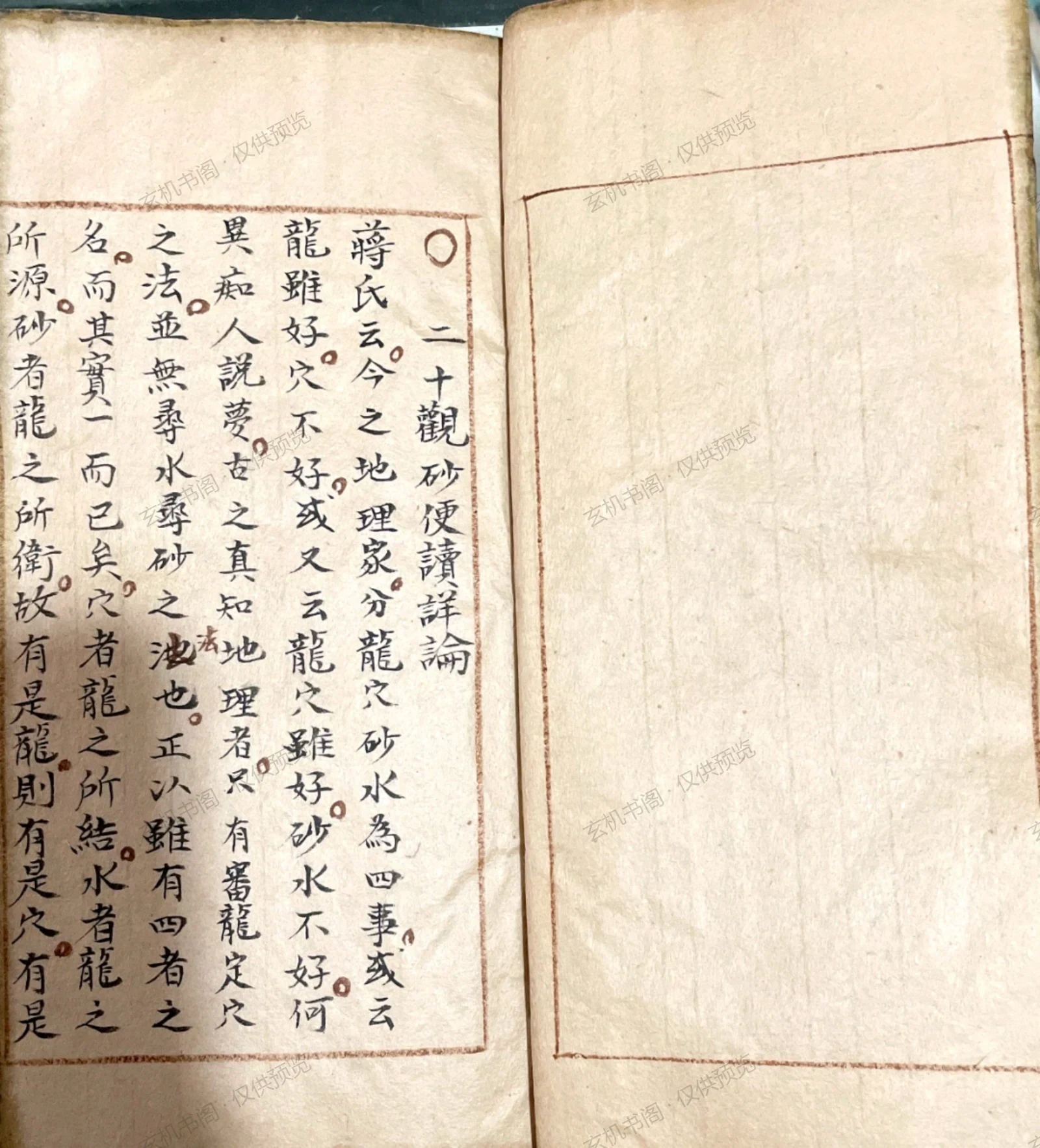
Twenty observations on sand: dividing dragon, cave, sand, and water
Key Points
Takes dragon, cave, sand, and water as the four main categories and stresses their coordination
Emphasizes sand orientation, approach, attendants, and rank
Includes sand-form diagrams for literary stars, treasury stars, flags, and drums
Argues sand and water are mutually complementary with dragon and cave, not to be judged one-sidedly
Written in mnemonic verses with dense terminology, requiring prior knowledge