Reading guide
Content guideOverview
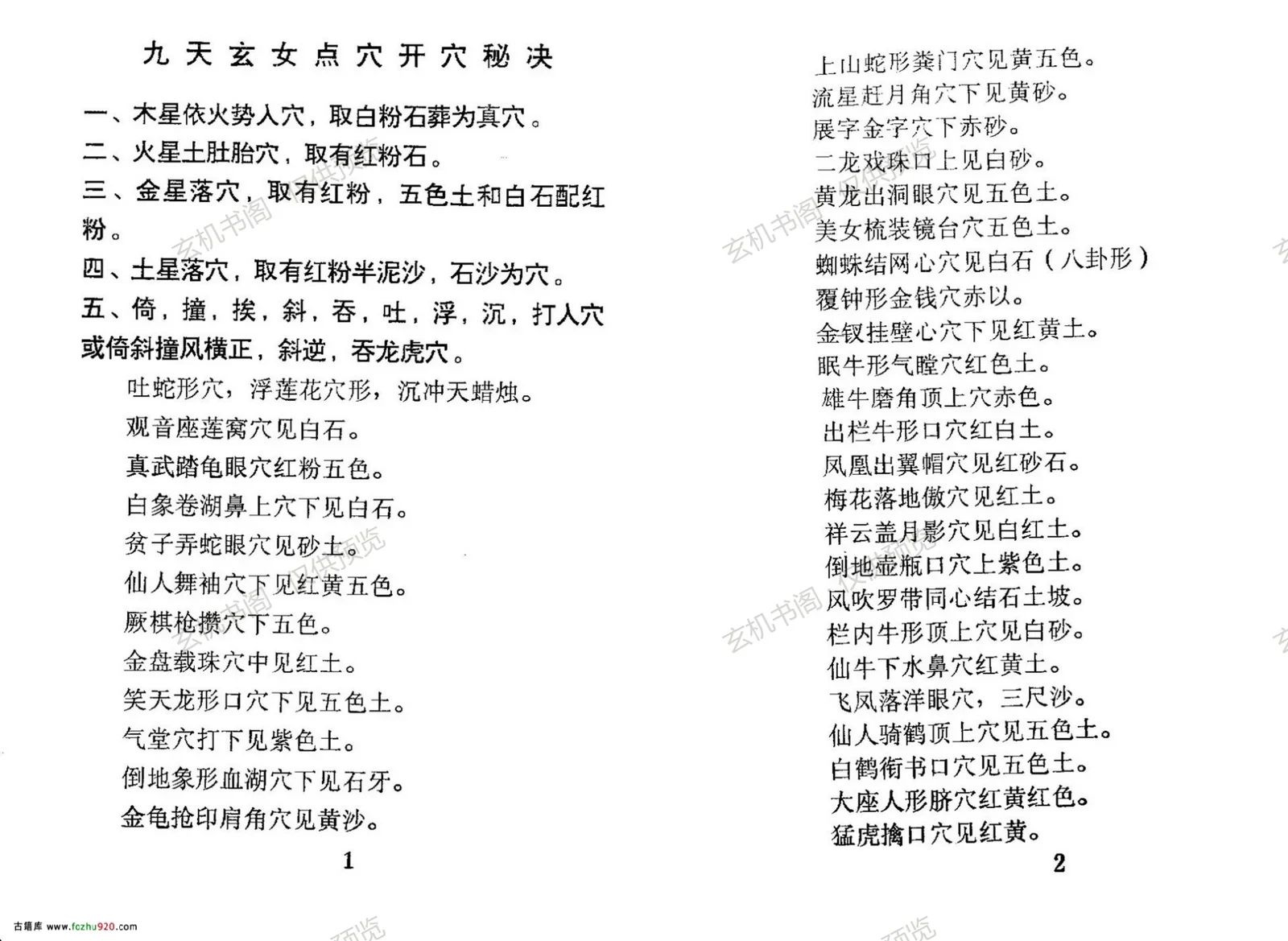
This is a compiled internal folk geomancy text titled Secret Methods of the Nine Heavens Mystic Woman for Locating and Opening Acupoints. According to the editorial note, it derives from a privately transmitted handwritten copy used to observe landforms and infer the sand, soil, and objects beneath the ground—such as red earth, yellow sand, white sand, and stone bowls—as a basis for deciding where to locate and open an acupoint. The main body lists entries for Wood, Fire, Metal, and Earth star formations entering points, along with many figurative acupoint names like Guanyin Seated on a Lotus Nest and the True Warrior Treading on a Turtle's Eye, noting the soil colors or stones seen below each. A second section, Grave Prognostications for the Twenty-Four Mountains, is organized by mountain orientation (Ren, Zi, Gui, Chou, Gen, Yin, Jia, Mao, Yi, Chen, Xun, Si, Bing, Wu, Ding, Wei, Kun, Shen, etc.) and discusses how wind gaps, water courses, high peaks, and sand formations relate to grave fortune and changes in the bones. The editor states that this section is drawn from Su Limin's Yin-Yang House Treasure Mirror for reference. The book preserves a large body of formulaic oral judgments and is useful for research on geomantic form methods and folk mantic literature, though its terse entries require background knowledge of traditional geomancy.
Contents
Editorial note and source of the text
Five elemental star formations and soil colors
Figurative acupoint names and what lies beneath
Grave prognostications for the twenty-four mountains
Ren, Zi, and Gui mountains
Gen, Yin, Jia, Mao, Yi, and Chen mountains
Xun, Si, Bing, Wu, and Ding mountains
Wei, Kun, Shen, and other mountains
Key Points
Judges acupoint locations by observing landforms and the soil or stones below.
Lists numerous figurative acupoint names such as Guanyin on a Lotus Nest and Golden Plate Carrying a Pearl.
Appends grave prognostications organized by the twenty-four mountain orientations.
Discusses wind gaps, water courses, and sand formations in relation to grave fortune and bone conditions.
The compiler notes a folk handwritten source and references Su Limin's Yin-Yang House Treasure Mirror.