Reading guide
Content guideOverview
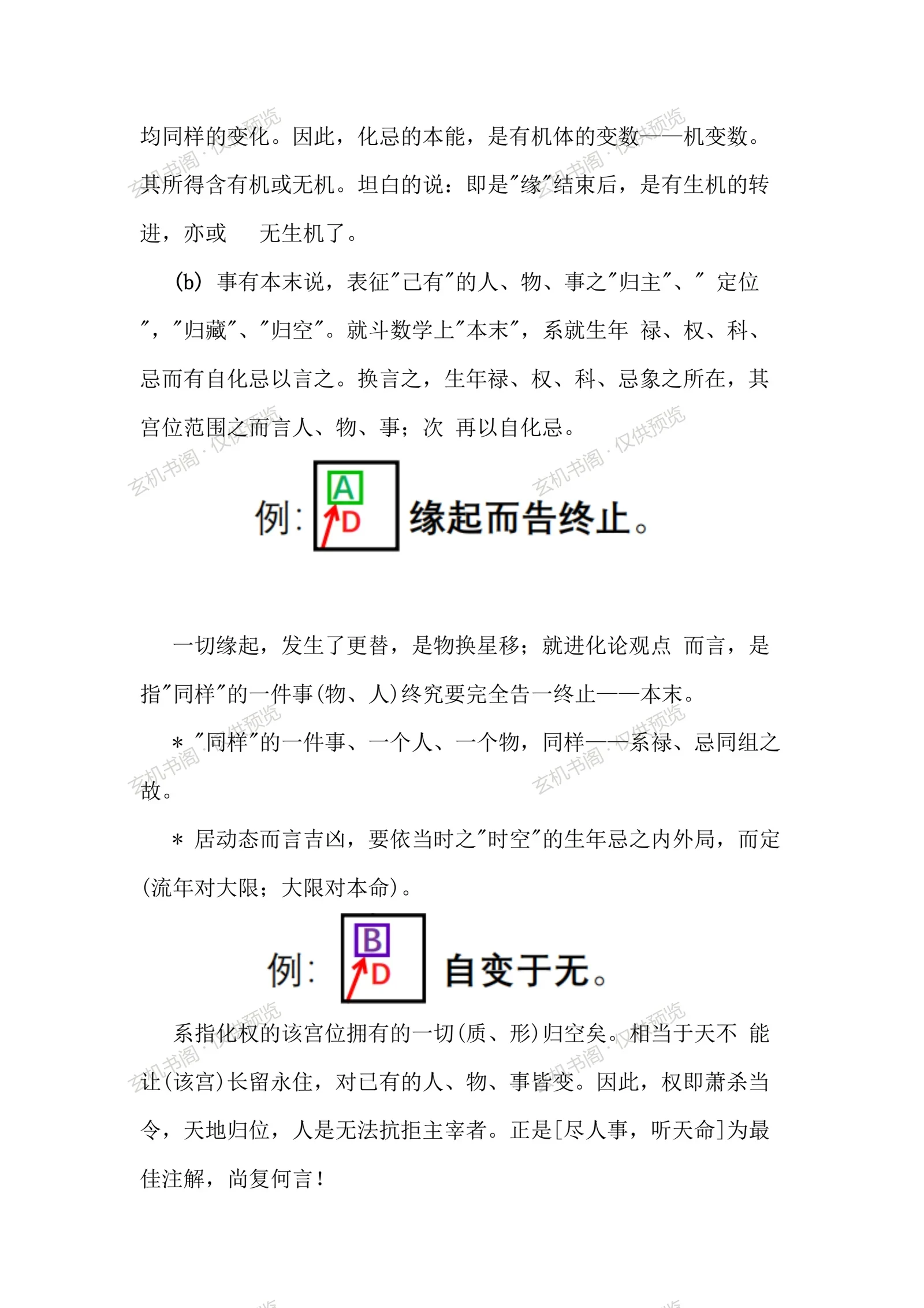
This is a compiled lecture text by Xu Quanren on the Qintian school of Zi Wei Dou Shu. The cover reads simply 'Ten Essentials of Destiny Analysis,' and the table of contents lists five essentials: defining natal four-transformation imagery, three images as one entity and four images as one origin, transformation qi and number with the laiyin palace and original imagery, Luoshu analysis, and an overview of image-number synthesis. The visible body text concentrates on the first essential. It begins with the origin of xiang as phenomenon, linked to the monistic qi cosmology and the relative sitting/shining relations of palaces. It then sets out methods for studying imagery: distinguishing person, event, and object; uniting palace and image; analyzing quality through composite structure; and forming an ontology through three images as one entity. The text assigns lu and ke to people and health, ji to objects, and quan to events, then defines each transformation: ji fixes position and wealth, lu concerns how wealth is gained, ke concerns people and karmic gatherings, and quan is the mediating agent. It repeatedly explains the linked movement of natal lu and ji, and illustrates with Tanlang lu in the life palace and Taiyang lu in the parents palace. The approach is advanced and structural rather than a dictionary of single-star readings.
Contents
Essential 1: defining natal four-transformation imagery
The command and content of images: people, events, objects
Rules of definition: lu-ji and quan-ke as mind-matter
Definitions: ji locates, lu gains, ke relates, quan mediates
Dissecting transformations: lu as origin, ji as endpoint
Essential 2: three images as one entity, four as one origin
Essential 3: transformation qi, number, laiyin palace
Essential 4: Luoshu analysis; Essential 5: image-number synthesis
Key Points
Starts from natal four transformations to establish imagery.
Lu and ke govern qi transformation and gathering; quan and ji govern gain, loss, and balance.
Ji locates and defines wealth; lu follows ji or ji follows lu.
Ke concerns people and karmic meetings; quan is the mediating agent.
Stresses palace-image unity and three images as one entity, not single-palace readings.