Reading guide
Content guideOverview
These are watermarked course notes from Xu Quanren's advanced Zi Wei Dou Shu class. The text first distinguishes the innate from the acquired: the innate concerns what is present at birth and causal continuity, linking destiny, substance, fixed numbers, and birth-year four transformations to space; the acquired concerns latent potential, variable outcomes, flying-palace four transformations, and self-transformation, linked to time. It then argues that reading a chart begins with the birth-year four transformations and the palace of origin, since an image exists in space but fortune is settled only when time arrives. The core section explains the three elements of palace, image, and star: palaces carry duties with surface and hidden meanings, images are the four transformations and serve as the chart's functional focus, and stars have no inherent good or bad but channel qi and describe personality. The notes also present a ten-character formula and a sample chart showing how to combine palace and image first, then add stars, before surveying the duties of the twelve palaces and key principles of interpretation.
Contents
Innate and acquired: birth-year vs. flying four transformations
Reading begins with birth-year transformations and palace of origin
Three elements: palace, image, star
The ten-character formula of Zi Wei Dou Shu
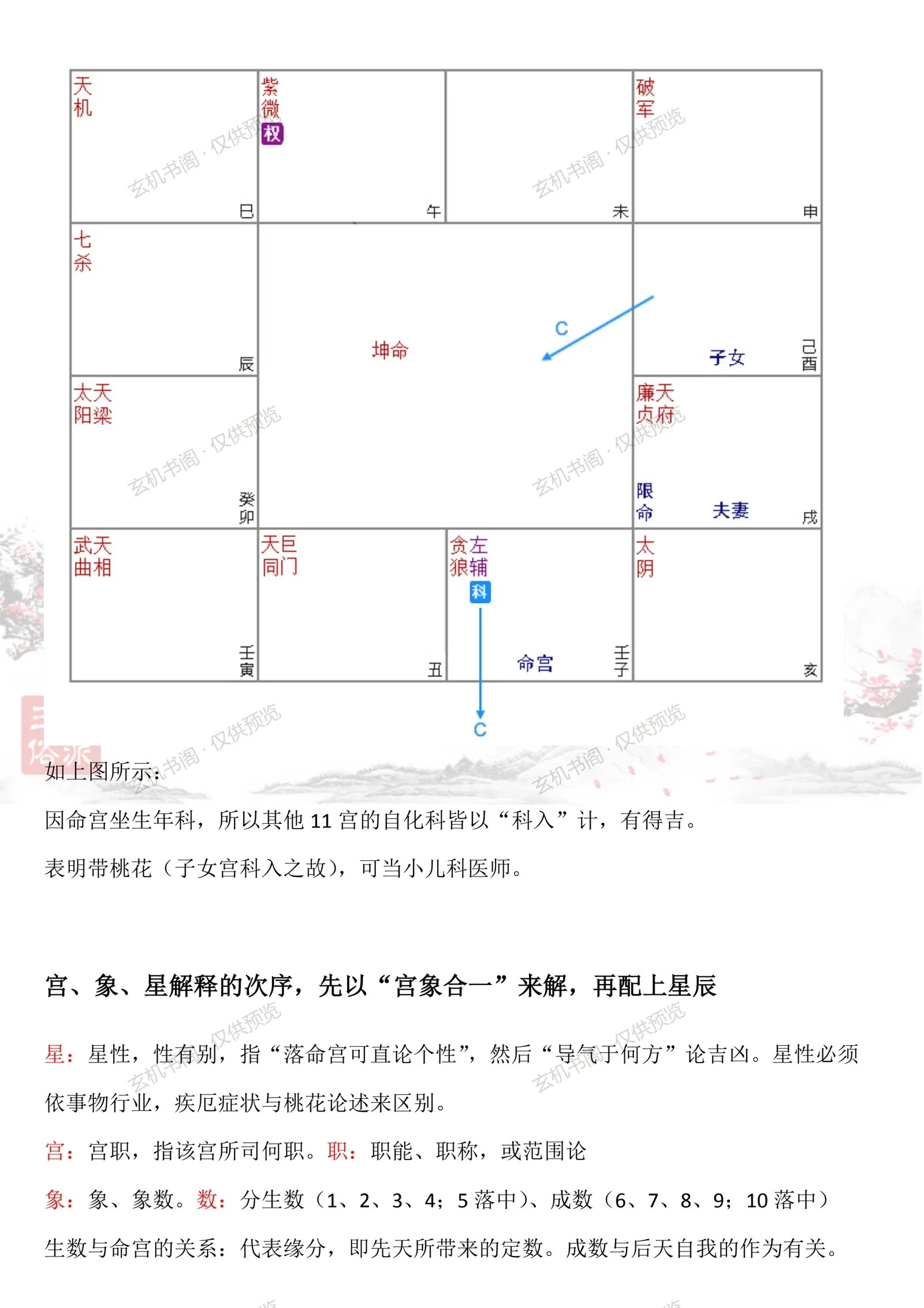
Sample chart: combine palace and image, then add stars
Duties of the twelve palaces and key interpretive principles
Key Points
Innate fixed numbers come from birth-year transformations; acquired variables from flying and self-transformations.
Among palace, image, and star, image is the functional focus; stars carry no fixed good or bad.
Palace duties include surface meanings and hidden meanings revealed by setting a new tai chi.
Interpretation order: unite palace and image first, then add stars to judge fortune.
Each of the twelve palaces has its own domain, with the life palace showing the overall pattern.