Reading guide
Content guideOverview
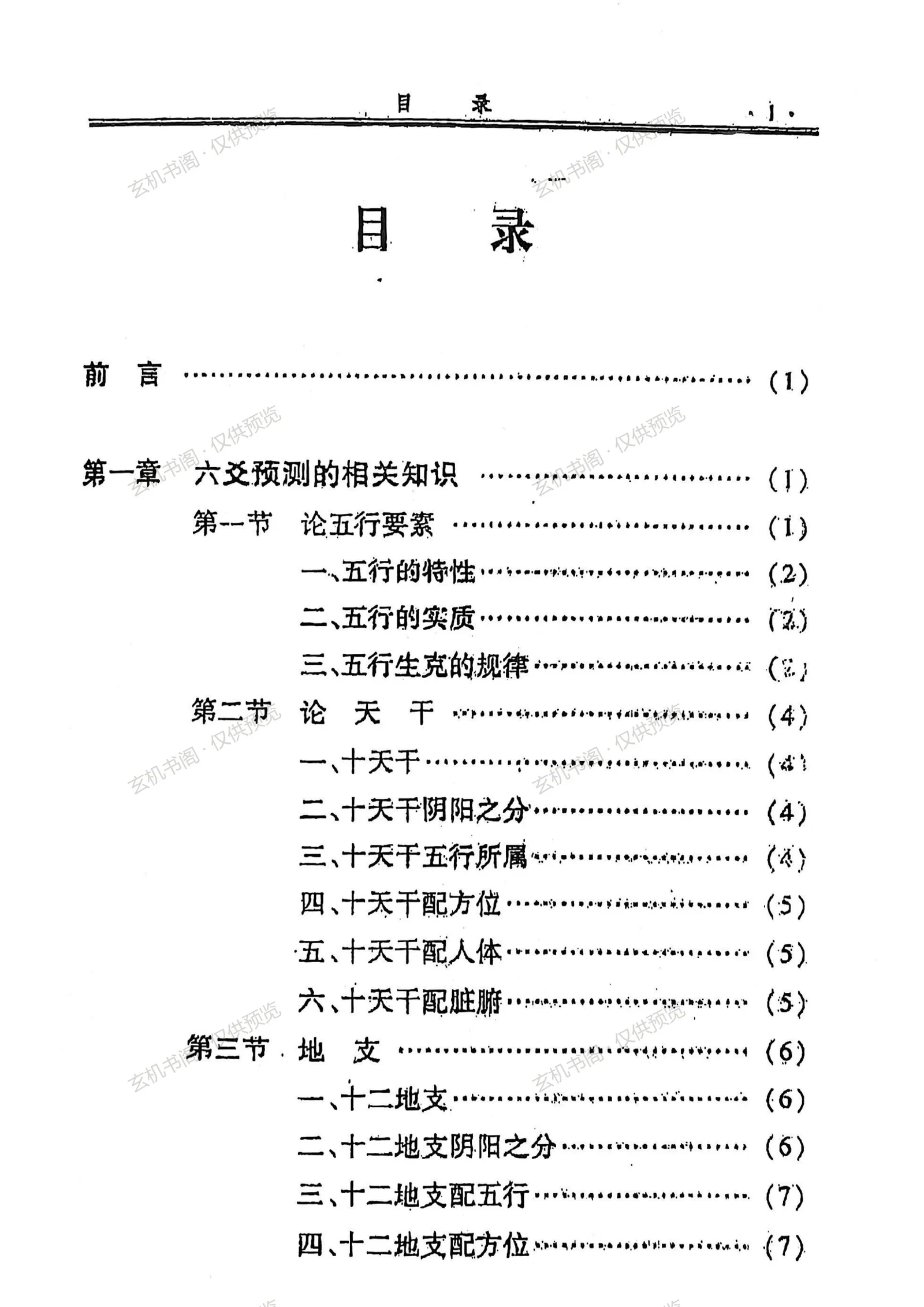
The cover identifies this as a special volume in a series on the systematic theory of Zhouyi prediction, titled Yili Cunzhen (Preserving the Truth of Yi Principles) and attributed to Shao Weizhong. The visible table of contents shows a progressive structure built around six-line divination. Chapter One, 'Related Knowledge for Six-Line Divination,' covers the characteristics, nature, and generating/overcoming rules of the five phases; the yin-yang, phase attributions, directional and bodily correspondences of the ten heavenly stems; the yin-yang, phases, directions, seasons, organs, monthly rules, solar terms, hours, zodiac and ordinal numbers of the twelve earthly branches; and the sixty-jiazi nayin table along with stem-branch methods of reckoning years, months, days and hours. Chapter Two, 'Basic Knowledge for Six-Line Divination,' moves to the eight trigrams and six lines, their formation, the prior- and post-heaven arrangements, the sequence of the sixty-four hexagrams, line images, numbers and positions, and identifying the body. Chapter Three, 'Introductory Knowledge for Six-Line Divination,' begins at page 38, but its content is not visible in these preview pages. Overall the book reads as a textbook-style groundwork for studying six-line divination.
Contents
Preface
Ch. 1 Related Knowledge for Six-Line Divination: the five phases
Sec. 1 Five phases: characteristics, nature, generating and overcoming
Sec. 2 Heavenly stems: yin-yang, phases, directions, body and organs
Sec. 3 Earthly branches: phases, directions, seasons, monthly rules, hours
Sec. 4 Stem-branch nayin and reckoning of years, months, days, hours
Ch. 2 Basic Knowledge: the eight trigrams and six lines
Ch. 3 Introductory Knowledge for Six-Line Divination
Key Points
Starts from the five phases to build the theoretical base of six-line divination
Detailed treatment of stems and branches, including directional and organ correspondences
Includes the sixty-jiazi nayin table and stem-branch dating methods
Chapter Two turns to trigram formation, prior/post-heaven arrangements and the sixty-four hexagrams
Covers line images, numbers, positions and identifying the body