Reading guide
Content guideOverview
This handout is a transcript-style lesson from Yiting's Zi Wei Dou Shu systematic course, lessons 09–19, centered on the Fan Shui Tao Hua (Overflowing Peach Blossom) pattern. It first clarifies that the pattern does not mean promiscuity: Greedy Wolf (Tan Lang) sitting in Zi, the northern water region, leaves its yang wood without root, producing a drifting, restless character that is sociable and ambitious, with changes in relatives and career in midlife and a tendency to roam or work abroad in later years. It then contrasts Tan Lang in Wu, where fire burns its wood, yielding a face-conscious, self-presenting personality that demands constant support. The lecture moves to the fixed spouse palace of Tan Lang, Lian Zhen and Tian Fu, described as heavy, conservative, home-loving and emotionally cool once a relationship stabilizes, and discusses the Chen-Xu heavenly net and the separated-corner clash that arises when the life and spouse palaces are divided by a travelling-horse palace, causing mutual misunderstanding. The final page presents the two-palace comparison method, reading marriage dynamics by contrasting the main stars of the life and spouse palaces, with a major limit triggering Lian Zhen transformed into Ji as the key signal of emotional change. The material is practical and example-driven, suited to readers who already know basic Zi Wei Dou Shu.
Contents
Fan Shui Tao Hua: Tan Lang in Zi drifts without root
Personality differences between Tan Lang in Zi and Wu
Tan Lang's spouse palace is always Lian-Fu
Heavenly net and separated-corner clash
Major limit triggering Lian Zhen Hua Ji
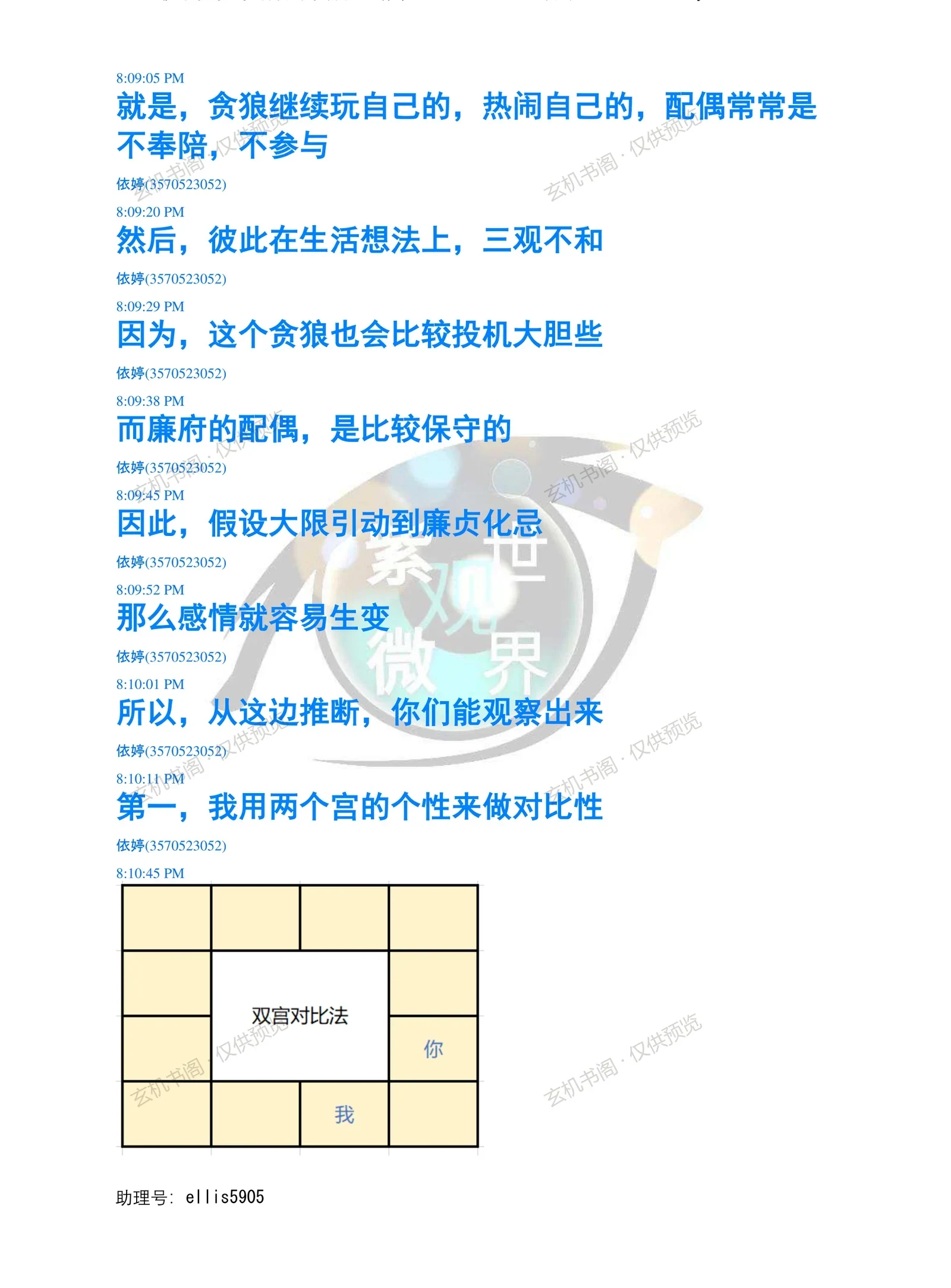
Two-palace comparison method for marriage reading
Key Points
The pattern concerns rootless wood in water, not promiscuity.
Tan Lang in Zi is sociable and ambitious; in Wu, image-conscious and dependent on support.
Lian Zhen and Tian Fu in the spouse palace suggest reserve and emotional coolness.
A travelling-horse palace between life and spouse palaces forms a separated-corner clash.
Lian Zhen Hua Ji activated by a major limit often marks emotional change.
The two-palace comparison method contrasts the stars of both palaces.