Reading guide
Content guideOverview
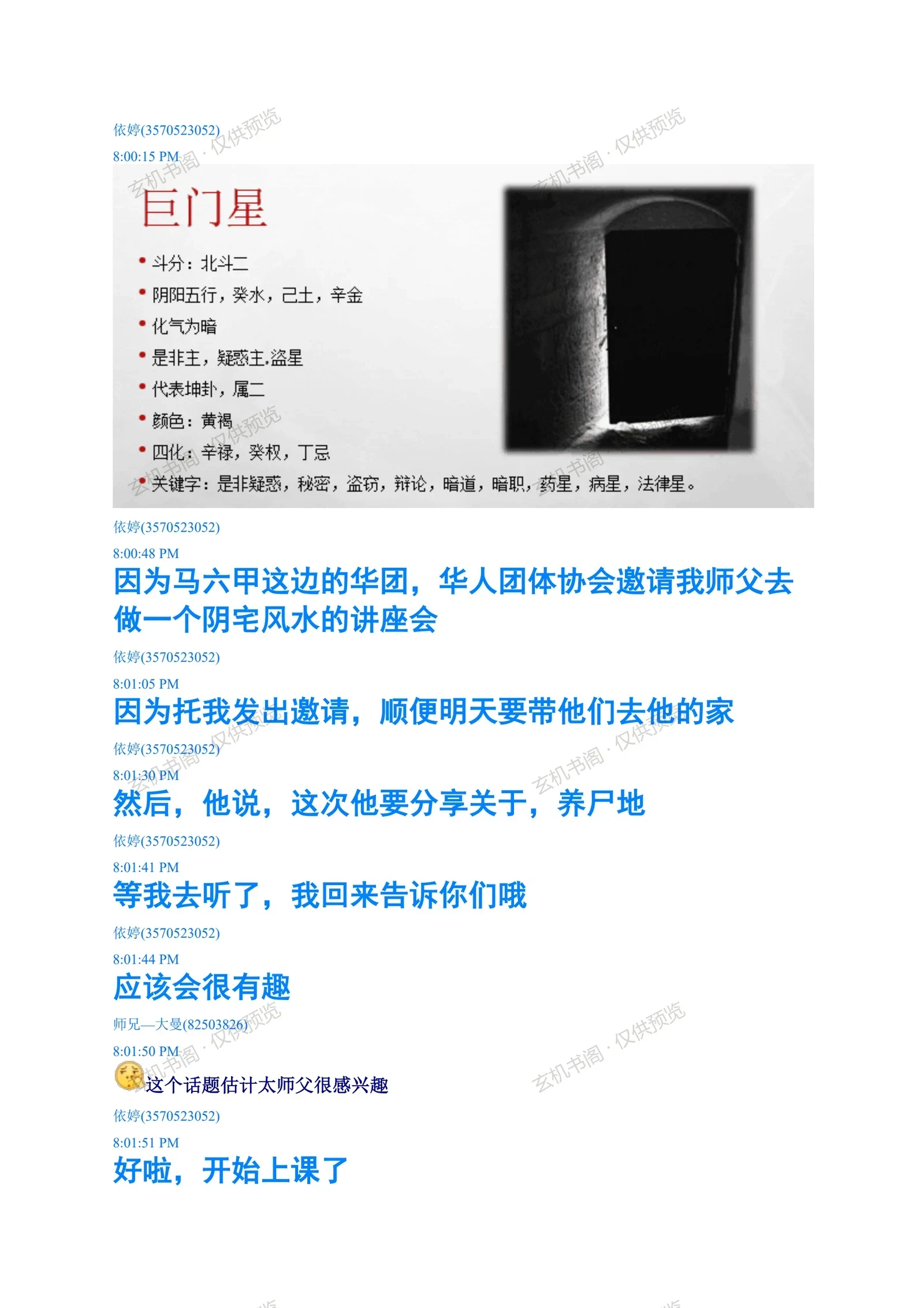
This is the 27th session transcript from Yiting's 2018 Zi Wei Dou Shu systematic course, presented as chat screenshots from a live class. The lesson centers on the star Giant Gate (Ju Men): its position as the second star of the Northern Dipper, its yin-yang and Five Element attributions of gui water, ji earth and xin metal, its nature of 'darkness,' its association with gossip, suspicion, secrets, theft, debate, hidden matters, medicine, illness and law, and its four transformations. The teacher then works through water imagery, distinguishing Ju Men's murky, black, underground or dirty water from Tai Yin's clean water, and links Ju Men with Po Jun through the one-six relationship and with Kong Jie as falling imagery, giving examples such as inferring swimming experience from Tai Yin with Kong Jie. The lesson also traces ji earth to the second black star of the Kun trigram, notes that xin metal is rarely used, and extends Ju Men as both medicine and illness star, with the Jie Shen palace also functioning as a problem palace. The conversational, example-driven format makes it useful as advanced reference for star-image and Five Element symbolism in Zi Wei Dou Shu.
Contents
Basic attributes and four transformations of Ju Men
Gui water imagery: dirty, underground, murky water
How Tai Yin and Ju Men differ in water imagery
Ju Men-Po Jun one-six relation and Kong Jie falling
Ji earth from the Kun trigram's second black star
Ju Men as medicine and illness star; Jie Shen palace
Key Points
Ju Men is the second Northern Dipper star, linked to darkness, gossip and secrecy
Its gui water is murky or underground, unlike Tai Yin's clean water
Ju Men and Po Jun form a one-six pair and are read together
Kong Jie indicates falling; Tai Yin with Kong Jie may suggest swimming
Ji earth comes from the Kun trigram's second black star; xin metal is rarely used
Ju Men is both medicine and illness star; Jie Shen palace can still be a problem palace